Where To Stay In Rome: Best Areas & Neighborhoods
Rome rewards anyone who sleeps inside the old center, close enough to walk out the door and reach a fountain, a ruin, or a plate of cacio e pepe before the day-trippers arrive. Choosing the right neighborhood is really about matching the streets to how you travel: a first visit, a romantic escape, a family week, or a tight budget.
The Rome neighborhood selector
Relative positions from this guide, based on the price feel and street character described in each section, not a fixed price index.
Which Area Of Rome Should You Stay In?
For a first visit, base yourself in the historic center around the Pantheon and Piazza Navona, or in Monti beside the Colosseum, both walkable to almost everything; pick Trastevere for atmosphere and dining, Prati for calm streets near the Vatican, and the Termini area for the cheapest beds and the best transport links. Rome's core is smaller than most people expect. The stretch from the Vatican in the west to Termini station in the east is only a few kilometres across, and first-timers routinely underestimate how much of it they can cover on foot.
Where you sleep decides how many of your steps go toward the sights and how many go back to a metro station at the end of a long day. Stay central and you pay more for the room, hear more noise from the piazzas, and walk everywhere. Stay a little out and the room is cheaper and quieter, but you trade twenty minutes each way to reach the Forum. Neither is wrong. The point is to choose on purpose rather than by whatever the booking site pushed to the top.
Here is how the five best-known areas compare on the things that actually shape a trip: the feel of the streets, how much you can do on foot, the price you should expect, and the kind of traveller each one suits. Use it as a shortlist, then read the section on the area that fits.
| Neighborhood | Vibe | Walkability | Price feel | Best for |
|---|---|---|---|---|
| Centro Storico (Pantheon, Piazza Navona) | Postcard Rome, lively squares | Excellent, few metro stops | Highest | First-timers who want to walk out into it |
| Monti | Old-Rome cool, local wine bars | Excellent, on Metro B | Mid to high | Ancient-Rome fans, style-minded couples |
| Trastevere | Cobbled, romantic, buzzing at night | Very good on foot, no metro | Mid to high | Couples, food lovers, night owls |
| Prati | Elegant, calm, residential | Good, on Metro A | Mid | Families, Vatican-focused stays |
| Termini / Esquilino | Busy transport quarter | Best transit, plainer streets | Lowest | Budget trips, early trains, day-trippers |
Before you lock anything in, it helps to know how you plan on getting around Rome day to day, because the value of a metro-linked base like Prati or Termini depends on whether you intend to ride it. Most visitors walk far more than they expect.
Centro Storico: The Pantheon And Piazza Navona Core
The centro storico is the tangle of cobbled lanes around the Pantheon, Piazza Navona and Campo de' Fiori, and it is the single best base for a first trip because you can walk to almost every famous sight and step straight into Roman street life the moment you leave your door. This is the Rome people picture: baroque fountains, café tables spilling into small squares, church façades appearing at the end of narrow streets. Sleep here and mornings start with an espresso taken standing at a bar counter, not with a commute.
The trade-off is money and noise. Rooms in the historic center sit at the top of the city's price range, and the streets around Piazza Navona and Campo de' Fiori stay loud well past midnight, especially on weekends. Light sleepers should ask for a room off the main squares or facing an internal courtyard. There is also almost no metro inside the district; the nearest Line A stations, Spagna and Barberini, sit at its eastern edge, so this is a walking base by design.
Walking is the whole appeal. From the Pantheon you are minutes from the headline sights, which is why so many people who ask about the best things to do in Rome end up basing themselves right here. These are the honest on-foot times from the Pantheon, useful for judging how central a hotel really is.
| From the Pantheon to | On foot | Notes |
|---|---|---|
| Piazza Navona | 4-5 min | Flat, always open |
| Trevi Fountain | 7-8 min | Busy by mid-morning |
| Spanish Steps | 12-14 min | Shops most of the way |
| Roman Forum & Colosseum | 18-22 min | Downhill going, uphill back |
| Trastevere | 15-20 min | Across Ponte Sisto |
| St Peter's / Vatican | 28-32 min | Or a short bus ride |
If your trip is short and sightseeing-dense, the extra nightly cost usually pays for itself in shoe leather and saved transit time. Anyone weighing how many days in Rome to spend often finds that a central base makes a tight two or three nights feel far longer.
Centro Storico is not for everyone. Light sleepers, families who want space and a kitchen, and anyone counting every euro will feel the trade-offs sharpest here, since rooms are small and dear and the weekend noise is real. If that is you, read on: Monti gives you almost the same central position for less, and Prati trades a little walking for calm. But for a first trip built around seeing as much as possible on foot, nothing beats waking up inside the old center.
Monti: The Local-Feeling Quarter By The Colosseum
Monti is Rome's oldest rione, wedged between the Colosseum, the Roman Forum and Termini, and it gives you ancient Rome on the doorstep with a lived-in, neighbourhood feel that the centro storico has partly lost to tourism. Ivy-draped lanes like Via dei Serpenti and Via del Boschetto are lined with vintage shops, natural-wine bars and small trattorias where you still hear Roman spoken at the next table. It has quietly become the area design-minded travellers ask for by name.
Location is the draw. You can stroll to the Colosseum in about ten minutes, and Cavour station puts you on Metro B, so a room in Monti hits a rare sweet spot: genuinely central, atmospheric, and still connected to the wider network. Prices run below the centro storico while staying above the city average, which is a fair deal for what you get.
The catch is that Monti is compact and popular, so the best small hotels and apartments book out early, and the bar-lined evenings can carry a low hum of noise on weekends. It suits ancient-Rome enthusiasts, couples who want character over grandeur, and anyone who wants to be near the Colosseum without paying centro-storico rates. If skip-the-line at the Colosseum is high on your list, sleeping this close means you can be at the gate before the queues build.
Monti also works as a compromise base for mixed groups. It is central enough for the sightseers, characterful enough for the couples, and connected enough for anyone who wants to range further, all without the centro storico price tag. If your party cannot agree on an area, this is often the room everyone ends up happy with.
Trastevere: Cobbled Lanes And The Best Evenings
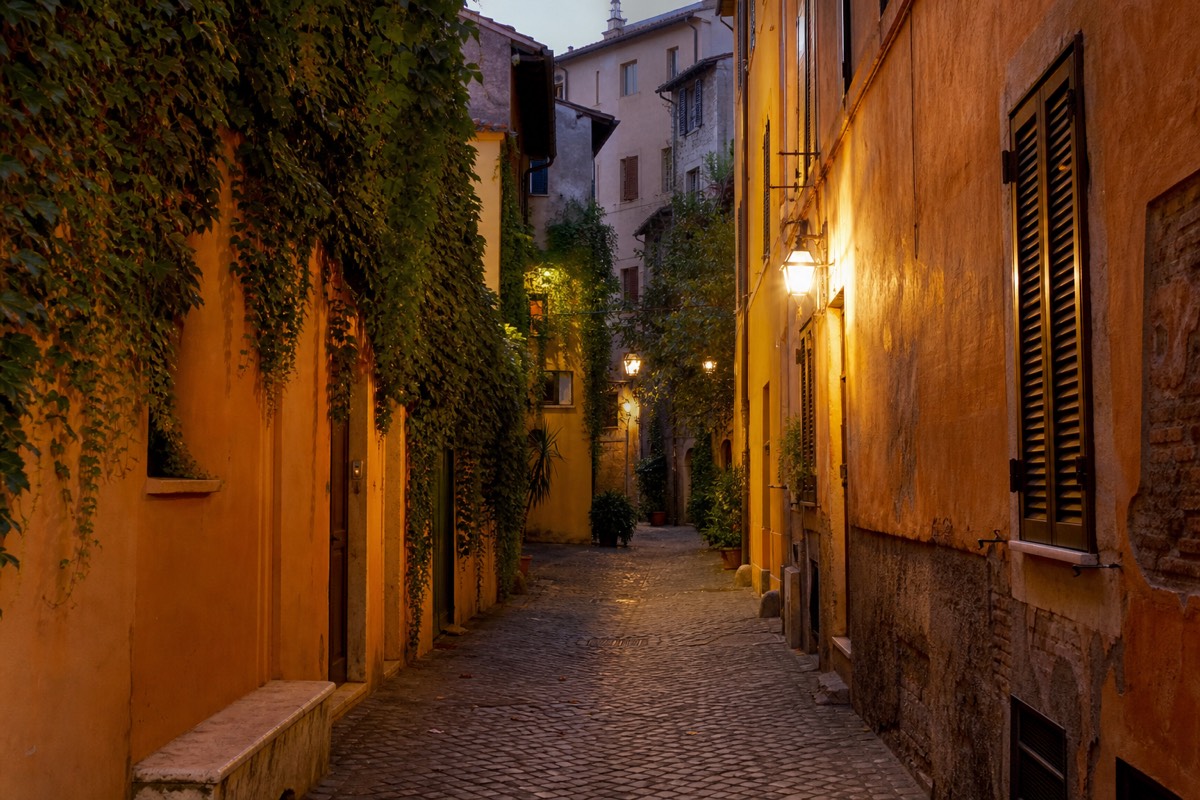
Trastevere sits across the Tiber from the historic center and is Rome's most atmospheric place to stay, a maze of ivy-covered lanes and small piazzas that turns into the city's best dining and drinking quarter after dark. By day it is sleepy and photogenic, all washing lines and worn cobbles. By evening the trattorias fill, musicians appear in Piazza di Santa Maria in Trastevere, and the neighbourhood earns its reputation. Couples and food-focused travellers tend to fall for it hardest.
This is a strong base if dinner and the walk home matter as much as the monuments. The eating here is some of the city's most reliable, and staying among it means you are never far from a plate of carbonara or a late gelato. Anyone reading up on what to eat in Rome will find half the shortlist within a few streets of the main square. Trastevere also sits within a fifteen to twenty minute walk of the historic center, so you are not truly cut off from the Pantheon and Piazza Navona.
The honest downsides: there is no metro station in Trastevere, so you lean on tram 8, buses, and your own feet, and the popular squares get loud and crowded on weekend nights. Families with early bedtimes and anyone who prizes quiet should choose a room in the calmer western lanes rather than over a bar. For couples chasing the classic Roman evening, though, few areas beat it.
Prati: Calm Streets Near The Vatican
Prati is the elegant, orderly district just north of the Vatican, built on wide nineteenth-century boulevards, and it is the calmest central base in Rome, which makes it a favourite for families and for anyone building their trip around the Vatican Museums. After the crush of the centro storico, Prati feels like exhaling: clean pavements, leafy streets, proper supermarkets, and the smart shopping strip of Via Cola di Rienzo. It is residential Rome that happens to sit next to one of the world's great museum complexes.
For Vatican-focused visitors the position is hard to beat. St Peter's Basilica and the museum entrance are a short walk away, so you can be first through the doors before the tour groups arrive. Prati is also well connected: Ottaviano and Lepanto stations put you on Metro A, three or four stops from the Spanish Steps and the historic center. Prices tend to sit a notch below the most central districts, which is part of the appeal for a family booking two rooms.
The trade-off is atmosphere. Prati is handsome but quiet, without the piazza life of Trastevere or Monti, and the stretch closest to the Vatican fills with souvenir stalls. If your priority is calm evenings, family-friendly streets and easy Vatican access, that quiet is a feature, not a flaw. Sightseers who want to fall out of bed into the buzz will prefer to sleep further east.
One underrated Prati perk is timing the Vatican. Staying a short walk from the entrance means you can book the earliest slot on the official Vatican Museums site and join the first admissions of the day, before the coach groups arrive and the galleries fill, then be back out for a late breakfast on Via Cola di Rienzo. Families also value the everyday practicality here: pharmacies, supermarkets and playgrounds that the tourist-facing center lacks. It is the base that feels most like living in Rome rather than visiting it.
Termini And Esquilino: Budget Beds And The Transport Hub
The area around Termini station holds Rome's widest range of budget and mid-range hotels and its best transport, because both metro lines, the airport train and most city buses meet here, though the streets themselves are practical rather than pretty. If your trip runs on a tight budget, or on early departures, or on a string of day trips, this is the logical base. You trade charm for connections, and for the right traveller that is a good trade.
Termini is the one point where Metro A and Metro B cross, the Leonardo Express from Fiumicino airport arrives here, and long-distance and regional trains fan out to the rest of Italy. Nothing else in Rome connects like it, which is exactly what makes it useful.
| From Termini | Connection | Handy for |
|---|---|---|
| Metro Line A | Direct to Spanish Steps, Vatican (Ottaviano) | Historic center, Vatican |
| Metro Line B | Direct to Colosseo, Circo Massimo | Ancient Rome |
| Leonardo Express | Nonstop to Fiumicino, about 32 min | Airport arrivals and departures |
| Regional & high-speed rail | Naples, Florence, Pompeii, and more | Day trips and multi-city routes |
The honest caveat is the immediate blocks. Right around the station, especially at night, the streets are workmanlike and less charming than the rest of the center, and this is where pickpockets work the crowds, so it pays to read up on whether Rome is safe and the common scams before you arrive. The good news is that Esquilino and the Monti side clean up quickly a couple of streets away. Termini is also where you launch the best day trips from Rome, from Pompeii to Florence, while some services use Tiburtina or other stations. For budget travellers, solo visitors watching costs, and anyone catching a dawn train, the practicality wins.
Esquilino, the quarter just south of the tracks, is worth a mention of its own. It holds Rome's most multicultural food scene, the sprawling Mercato Esquilino, and some of the best-value eating in the center, alongside grand but faded nineteenth-century streets. It will never be Trastevere for looks, yet for a traveller who wants low prices, real neighbourhood life and a station on the doorstep, it delivers more than its reputation suggests.
Where Not To Stay, And Going In With Eyes Open
Avoid booking a cheap-looking hotel far outside the center to save money, and be selective right at Termini at night; the biggest lodging mistake in Rome is trading a walkable base for a long daily commute you did not budget for. A room that looks like a bargain in the suburbs often costs you an hour of transit each day and the whole point of staying in Rome, which is to be inside it. The table below sums up the honest watch-outs by area so you can book with clear eyes.
| Area | Watch out for | Still worth it? |
|---|---|---|
| Centro Storico | Highest prices, weekend square noise | Yes for a first trip, if the budget allows |
| Trastevere | Loud on weekend nights, no metro | Yes for couples and food lovers |
| Immediate Termini blocks | Gritty streets, pickpockets at night | Yes on a budget, pick your street carefully |
| Far outer suburbs | Long commutes eat your sightseeing time | Rarely worth the saving |
| Anywhere without checking reviews | Traffic noise, fifth-floor walk-ups | Read recent reviews first |
Rome is safe for visitors overall, and the risks are the ordinary big-city ones. Keep your bag zipped and in front of you on crowded buses, while staying alert to your surroundings.
How To Match A Neighborhood To Your Trip
Match the area to your travel style: first-timers and short stays do best in the centro storico or Monti, couples in Trastevere, families in Prati, and budget or day-trip travellers around Termini. There is no single best neighbourhood in Rome, only the one that fits the trip you are actually taking. The two tables below turn that into a quick decision, first by who you are travelling as, then by how many nights you have.
| Travelling as | Best base | Why |
|---|---|---|
| First-timers | Centro Storico or Monti | Walk to nearly everything, deep in the atmosphere |
| Couples | Trastevere | Romantic lanes, the city's best evenings |
| Families | Prati | Calm streets, space, easy Vatican access |
| Budget travellers | Termini / Esquilino | Cheapest beds, best transport |
| Nightlife-minded | Trastevere or Monti | Bars and life on the doorstep |
The length of your stay matters just as much. A tight two nights argues for the most central base you can afford, so you spend the little time you have among the sights rather than on a bus. With more nights you can trade some centrality for space or value. Anyone still weighing three days in Rome against a longer stay will find the base decision follows naturally from the day count.
| Length of stay | Suggested base | Logic |
|---|---|---|
| 1-2 nights | Centro Storico | Maximise walkable time, skip transit |
| 3 nights | Centro Storico or Monti | Central, atmospheric, still connected |
| 4-5 nights | Monti, Trastevere or Prati | Room to breathe, day-trip access |
| Families, any length | Prati | Space and calm win over nightlife |
A last practical tip: whatever area you choose, read the most recent reviews for noise, and check the exact walk to the nearest sight on a map, because two hotels on the same street can feel very different. A quiet courtyard room in a lively district often gives you the best of both, atmosphere on the doorstep and sleep when you need it.
If sorting hotels, transfers and day-by-day logistics sounds like more than you want to take on, a done-for-you trip can reduce the number of separate bookings. The team at Rome Tour Packages builds most of its Rome stays around the historic center for exactly the reasons above, so the walking is short and the mornings are yours. A city-and-coast route such as the multi-day La Dolce Vita experience departs Rome for Sorrento, Pompeii and Capri; Rome hotel nights are separate, while the faster Ciao Italia itinerary anchors you in Rome before running south to Naples. Both handle the where-to-sleep question before you ever land. Whichever way you go, the same rule holds: pick the area first, then the room, and let the neighbourhood do half the work of your trip.