Things To Do In Rome: Top Sights & Experiences
Rome stacks three thousand years of history into a historic center you can cross on foot, so the hard part is never finding something to do, it is choosing what to see first. This guide runs through the sights that earn their place, groups them so you are not walking back and forth across the city, and shows how to fit them into the days you actually have.
How long to budget for Rome's core sights
Rough time allowances for Rome's main sights, drawn from typical visit lengths. Treat them as planning guides, and always check current opening hours and ticket slots.
What Are The Top Things To Do In Rome?
Almost every first visit is built around the same short list: the Colosseum with the Roman Forum and Palatine Hill, the Vatican Museums with the Sistine Chapel and St Peter's Basilica, the Pantheon, and the run of Trevi Fountain, Piazza Navona and the Spanish Steps, with an evening in Trastevere and a morning in the Villa Borghese gardens close behind. That is the core, and it is genuinely worth the hype. The rest of the city rewards wandering, but if you see those places well and leave time to sit in a piazza with a coffee, you will have understood Rome better than a visitor who sprinted through twenty sights.
The trick is grouping. Rome's headline sights sit in three loose clusters: the ancient zone southeast of the center, the Vatican across the river to the west, and the Baroque heart in between. See a cluster in a block rather than ping-ponging between them, and you save hours. The table below is the shortlist most itineraries draw from, with a realistic time budget and a note on what needs booking.
| Sight | Why it earns your time | Time to budget | Book ahead? |
|---|---|---|---|
| Colosseum, Forum and Palatine | The arena of ancient Rome plus the ruins of its civic and imperial heart | About half a day | Yes, timed entry |
| Vatican Museums and Sistine Chapel | Kilometres of collected art that end at Michelangelo's ceiling | Half a day | Yes, slots sell out |
| St Peter's Basilica | The largest church in the world, free to walk into | 1 to 2 hours | No ticket, expect a security line |
| Pantheon | The best preserved building of ancient Rome, still roofed by its dome | 30 to 45 minutes | Small entry fee, reserve on busy days |
| Trevi Fountain | Rome's grandest Baroque fountain, best at dawn or late night | 20 minutes | Upper piazza free; basin access EUR 2, exemptions apply |
| Piazza Navona | Bernini's Fountain of the Four Rivers on a stadium-shaped square | 20 to 30 minutes | No |
| Trastevere | Cobbled lanes and the best of the city's evening tables | An evening | No, book dinner on weekends |
| Galleria Borghese | Bernini sculpture and Caravaggio inside a garden villa | 2 hours | Yes, strict timed slots |
How much of this you reach depends on the calendar as much as your stamina. The best time to visit Rome for comfortable walking is spring and early autumn, roughly April to June and September to October, when daytime temperatures sit around 18 to 26 degrees Celsius and the queues are shorter than the July peak. Book the two ticketed heavyweights, the Colosseum and the Vatican, before anything else, because they are the sights most likely to sell out from under a last-minute plan.
Inside The Ancient Core: The Colosseum, Roman Forum And Palatine Hill
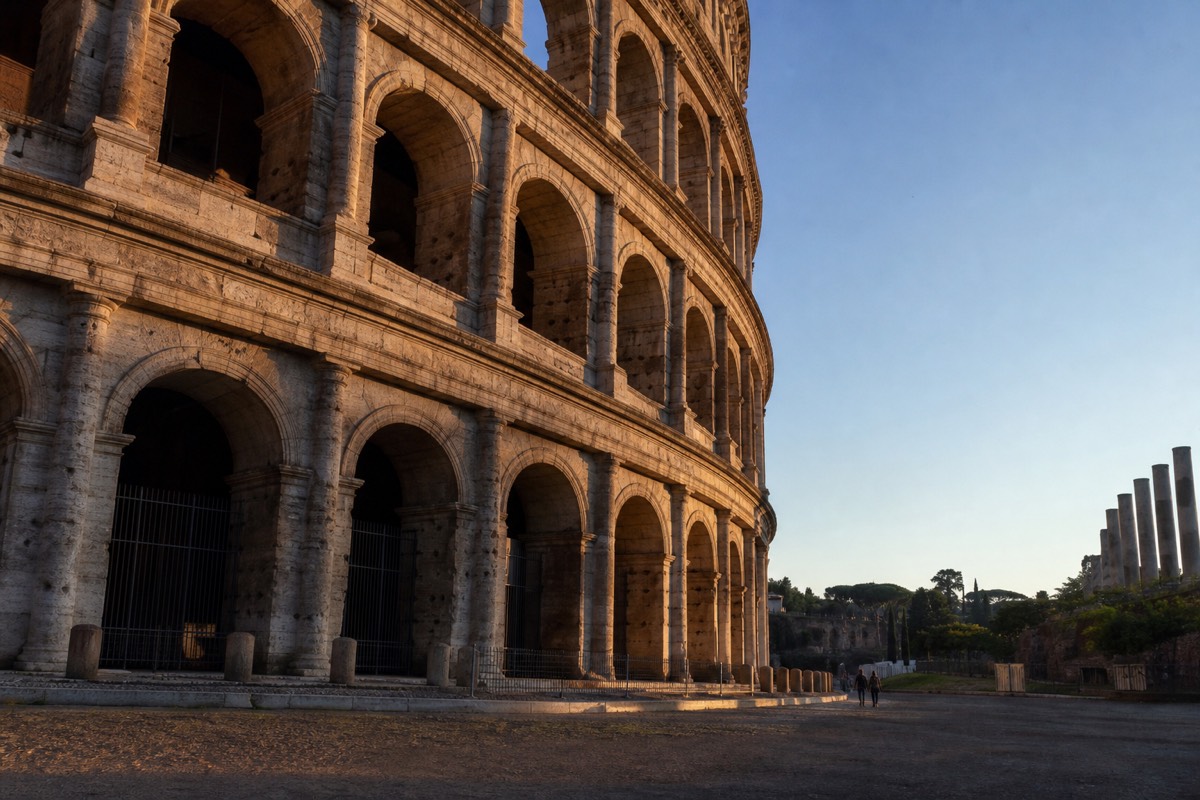
The Colosseum, the Roman Forum and the Palatine Hill sit side by side and share a single combined ticket valid across all three for one visit, so treat them as one long morning rather than three separate stops. Start at the Colosseum before the mid-morning rush, then walk uphill through the Forum and finish on the Palatine, where the emperors lived and the views back over the ruins are the best in the zone.
The amphitheatre held tens of thousands of spectators for gladiatorial games, staged hunts and public spectacle, and standing on the reconstructed arena floor is a different experience from looking down from the tiers. Guided access to the arena floor and the underground hypogeum, where animals and fighters waited below the sand, is limited and worth reserving if that is the version you want. Colosseum tickets are sold as a timed slot, and the official ticketing runs through the Parco archeologico del Colosseo, so buy from there or through a tour that bundles a guide and skip-the-line entry.
Two practical notes save the most grief here. The standard combined ticket lets you into the Colosseum once and the Forum and Palatine within a 24-hour window, while Full Experience options have different arena and underground access; choose the exact option rather than assuming every upgrade includes both, so decide which version you want before you book rather than at the gate. And go early or late: the first entry slots and the last two hours of the afternoon are far quieter than the 10am to 2pm crush, and the low sun over the Forum late in the day is also when it photographs best. On the way in, the Arch of Constantine stands right beside the amphitheatre, the largest surviving triumphal arch in the city, and costs nothing to admire.
The Forum is where daily Roman life happened: law courts, temples, the Senate house and the road that triumphal processions marched down. It reads as a field of broken columns until someone explains what stood where, which is why this is one part of Rome where a guide changes the visit. The Palatine above it is quieter, greener and often skipped, which is exactly why it is a good place to slow down. The team at Rome Tour Packages builds most of its Italy itineraries around this ancient core, then folds in the Vatican and a slower afternoon in the center.
| Site | What you are looking at | Don't miss |
|---|---|---|
| Colosseum | The 1st-century amphitheatre of the games | Arena or underground areas only with the corresponding access option |
| Roman Forum | The civic and religious heart of the ancient city | The Arch of Titus, the Curia and the Temple of Saturn |
| Palatine Hill | The imperial palaces and gardens above the Forum | The Farnese Gardens and the terrace view over the Forum |
| Nearby | Piazza del Campidoglio and the Capitoline Museums | The Michelangelo-designed square, a five-minute walk on |
The Vatican: Museums, Sistine Chapel And St Peter's Basilica
The Vatican is really two visits in one: the Vatican Museums, a long chain of galleries that ends at the Sistine Chapel, and St Peter's Basilica next door, which is free to enter but keeps its own security line. Do the museums first thing, ideally on an early or reserved slot, then cross to the basilica, and you sidestep the worst of both queues in a single morning.
The museum route is long, so pace it. The highlights people travel for are the Raphael Rooms, the Gallery of Maps with its painted 16th-century view of Italy, and finally the Sistine Chapel, where Michelangelo's ceiling and his later Last Judgment fill the room. The chapel is kept silent and no photos are allowed, so put the camera away and look up. Sistine Chapel tickets are sold as part of the Vatican Museums entry, not separately, and the museums close on most Sundays apart from the last Sunday of the month, when entry is free and the crowds are heavy.
St Peter's is the payoff. It is the largest church in the world by interior, and the scale only lands once you are inside under Michelangelo's dome. Look for his Pieta near the entrance, protected behind glass. If your legs are willing, the dome climb is the best view in Rome, roughly 551 steps to the top, or fewer if you take the lift to the roof and climb the rest. A dress code applies across the whole Vatican: shoulders and knees covered for everyone, so pack a light layer even in summer. Both official ticketing sites, the official Vatican Museums site and the Colosseum's, are the right places to confirm current hours and prices.
A few Vatican habits pay off. Book the earliest slot you can, because the galleries fill from mid-morning and the single corridor toward the Sistine Chapel slows to a shuffle by noon. Do not skip the Pinacoteca, the painting gallery near the entrance that most rushed visitors walk past, and look for the double-helix Bramante staircase on the way out. And do not try to pair the Vatican and the Colosseum in one day: each deserves its own morning, and doing both back to back leaves you too tired to enjoy either.
| Space | Highlight | Practical tip |
|---|---|---|
| Vatican Museums | Raphael Rooms and the Gallery of Maps | Reserve a morning slot, the corridors clog by late morning |
| Sistine Chapel | Michelangelo's ceiling and Last Judgment | Silence enforced, no photos, no bare shoulders |
| St Peter's Basilica | Michelangelo's Pieta and the main nave | Free entry, separate security queue, cover knees |
| St Peter's dome | The panorama over the square and the city | About 551 steps, or take the lift partway |
The Pantheon And Rome's Piazzas And Fountains
The Baroque center packs the Pantheon, the Trevi Fountain, Piazza Navona and the Spanish Steps within a fifteen-minute walk of one another, so this cluster is a single loop on foot rather than a set of separate errands. Do it early in the morning or after dark to beat both the heat and the densest crowds, and you get the same sights with room to breathe.
The Pantheon is the standout. Built as a temple and later a church, it has stood roofed for nearly two thousand years, and its coffered dome with the open oculus at the center is still the largest unreinforced concrete dome ever built. Rain falls straight through the oculus onto a slightly sloped floor that drains it away. A small entry fee was introduced in 2023, so check the current rate or reserve ahead on the busiest days. From there it is a short walk to the Trevi Fountain, where the tradition is to toss a coin over your shoulder to guarantee a return to Rome. The coins are collected regularly and given to a Catholic charity that runs services for the city's poor.
Piazza Navona sits on the outline of an ancient stadium, which is why it is long and rounded at the ends, and its centerpiece is Bernini's Fountain of the Four Rivers. The Spanish Steps climb from Piazza di Spagna up to the Trinita dei Monti church, 135 of them, past the house where the poet John Keats died. One rule catches visitors out: sitting on the Spanish Steps is banned and fines are handed out, so admire them and move on. These squares are also where pickpockets work the crowds, so if you are wondering whether Rome is safe, the honest answer is that it is, with the same street sense you would use in any busy capital.
Two more stops sit inside this same loop. Campo de' Fiori holds a morning market and turns into a square of busy bars by night, a short walk from Piazza Navona. A few minutes on toward the river stands Castel Sant'Angelo, the round fortress built as the emperor Hadrian's tomb, whose ramparts give one of the best rooftop views back over St Peter's dome. Neither needs a full visit, but both slot naturally into an evening walk between the fountains and the Tiber.
| Stop | Landmark | Best time to go |
|---|---|---|
| Pantheon | The dome and open oculus | Right at opening, before tour groups arrive |
| Trevi Fountain | The Baroque fountain and coin toss | Dawn or after 10pm for space to see it |
| Piazza Navona | Bernini's Fountain of the Four Rivers | Early evening as the cafes fill |
| Spanish Steps | The 135 steps and Piazza di Spagna | Morning, and remember you cannot sit on them |
Trastevere, Villa Borghese And The Quieter Side Of Rome
Once the headline sights are behind you, Rome's mood shifts in two directions worth chasing: the cobbled evening streets of Trastevere across the river, and the calm of the Villa Borghese gardens with the Galleria Borghese inside them. These are the parts that turn a checklist trip into an actual stay.
Trastevere is where locals and visitors both eat well. By day it is a tangle of ochre lanes, ivy and small workshops around the Basilica di Santa Maria in Trastevere, whose gold mosaics are among the oldest images of the Virgin in the city. By night it fills with people moving between trattorias and wine bars. Book a table on Friday or Saturday. This is also the neighbourhood many first-timers ask about when they are deciding where to stay in Rome, because it trades a longer walk to the ancient sights for the best evening atmosphere in the city.
The Villa Borghese is Rome's great central park, a place to rent a rowing boat on the lake, walk the shaded avenues or ride the terrace at the Pincio for the sunset view over the rooftops. At its edge, the Galleria Borghese holds one of the finest small collections anywhere: Bernini's Apollo and Daphne and his David caught mid-motion in marble, alongside Caravaggio paintings. Entry is by strict two-hour timed slot and it sells out days ahead, so book before you arrive. For a break from the city entirely, the best day trips from Rome, from the gardens of Tivoli to the ruins of Ostia Antica or a longer run down to the Amalfi Coast, are close enough to slot into a week without moving hotels.
For views and quiet, two spots reward the short climb up the Aventine Hill: the Giardino degli Aranci, the orange garden with a terrace over the whole city, and beside it the famous keyhole in the gate of the Knights of Malta, which frames St Peter's dome perfectly down a hedged avenue. Out along the ancient Appian Way, the catacombs open a different side of the city again, miles of early Christian burial tunnels cut into soft rock, cool and sombre on a hot afternoon and reachable on a half-day trip.
How Rome's Sights Cluster: A District-By-District Map
Rome's must-sees fall into a handful of walkable districts, and once you can picture where each one sits, the whole trip plans itself: the ancient zone in the southeast, the Vatican across the Tiber to the west, the Baroque center between them, Trastevere just south of the river and the green Borghese quarter to the north. Base yourself near the center and you can reach most of it on foot.
Getting around Rome is easiest by walking in the historic core, with two metro lines, A and B, crossing at Termini station to cover the longer hops. If you are arriving from Fiumicino airport, the Leonardo Express train reaches Termini in about half an hour. The map below is the mental model most visitors end up using, and it is why grouping sights by area beats chasing them in the order a list happens to print them.
| Area | Main sights | The feel |
|---|---|---|
| Ancient zone (Monti, Celio) | Colosseum, Forum, Palatine, Capitoline | Ruins and Roman history, a short walk to the center |
| Historic center (Centro Storico) | Pantheon, Piazza Navona, Trevi, Spanish Steps | Baroque squares, best for first-timers on foot |
| Vatican and Prati | Vatican Museums, Sistine Chapel, St Peter's | Grand and orderly, good value hotels, quieter evenings |
| Trastevere | Santa Maria in Trastevere, food and nightlife | Cobbled and lively, the city's dinner district |
| Borghese and the north | Villa Borghese gardens, Galleria Borghese | Green and calm, art and a sunset terrace |
How Many Days Do You Need, And How To Pace It?
Three full days is the honest minimum to see Rome's core without rushing, one for the ancient zone, one for the Vatican and one for the Pantheon-and-piazzas center, and five to seven days if you want the city plus a day trip or a second Italian city. Fewer than three and you are choosing between the Colosseum and the Vatican rather than doing both properly.
If you have exactly three days in Rome, the classic split is Ancient Rome on day one, the Vatican on day two and the historic center on day three, with an evening in Trastevere folded into whichever night suits. The question of how many days in Rome is really a question of appetite: art lovers want more Vatican time, families want more gelato-and-piazza time, and a coin-toss return trip solves the rest. Anyone building a wider Italy itinerary usually pairs Rome with Florence and Venice, the country's classic first-timer route.
Pre-planned multi-day packages take the booking maths off your plate, which is where the trips on this site fit. The five-day Ciao Italia route pairs Rome's Colosseum, Trevi and Vatican with Naples and easy reach of Pompeii. Italy in a Week starts in Naples with Pompeii, Vesuvius and Capri, then runs by train to Rome for the Colosseum, Forum and Vatican. La Dolce Vita heads the other way, from Rome down to Sorrento, Pompeii and Capri's Blue Grotto. Each itinerary has different hotel, transfer and admission inclusions. La Dolce Vita is a southern extension and does not include Rome sightseeing; security queues remain at major sites.
| Days | What fits comfortably | Good for |
|---|---|---|
| 1 day | Either the Colosseum zone or the Vatican, plus a center walk | A stopover, not a real visit |
| 3 days | Ancient Rome, the Vatican and the Baroque center, plus one Trastevere evening | First-timers who want the core done well |
| 5 days | All of the above at a slower pace, plus Galleria Borghese and one day trip | A relaxed first trip with breathing room |
| 7 days | Rome in full plus Naples, the Amalfi Coast or a second city | Combining Rome with the rest of Italy |
Eating In Rome: The Plates Worth Ordering
Roman food is built on a handful of simple, assertive dishes, and knowing what to eat in Rome saves you from the tourist-menu traps around the big sights: order the four classic pasta plates, street-food supplì and pizza al taglio, and finish with a proper gelato. Eat two streets back from any major fountain and both the price and the quality improve.
The four Roman pastas are the ones to learn: cacio e pepe (pecorino and black pepper), carbonara (egg, pecorino, guanciale and pepper, never cream), amatriciana (tomato, guanciale and pecorino) and gricia, the white ancestor of amatriciana. Around them sit the small plates: supplì, the fried rice-and-mozzarella croquettes, pizza al taglio sold by weight, carciofi alla romana in artichoke season, and maritozzo, a cream-filled bun eaten at breakfast. For the deepest version of this, the Testaccio neighbourhood and its covered market are where Roman food culture is strongest, and a guided food walk there is one of the better uses of an afternoon.
Coffee and gelato come with their own local rules. Romans drink espresso standing at the bar, usually cheaper than a table and always quicker, and a cappuccino is treated as a morning drink that few locals order after lunch. For gelato, walk past the counters piled with bright fluorescent mounds near the big sights and look for muted natural colours in covered tubs, the sign that the pistachio and the fruit are the real thing. A scoop eaten on the move between two piazzas is one of the small, dependable pleasures of the city.
| Dish | What it is | Where it shines |
|---|---|---|
| Cacio e pepe | Pasta with pecorino and black pepper, nothing else | Any honest trattoria off the tourist strip |
| Carbonara | Egg, pecorino, guanciale and pepper, no cream | Testaccio and the working-class quarters |
| Supplì | Fried rice croquette with a molten mozzarella center | Pizzerias and street counters |
| Pizza al taglio | Rectangular pizza sold by weight, folded to go | Bakeries near the Pantheon and Campo de' Fiori |
| Maritozzo | Sweet bun split and filled with whipped cream | A morning cafe before the sights open |
Put those pieces together and Rome stops feeling like a checklist. See the ancient core, do the Vatican properly, walk the piazzas early or late, keep an evening for Trastevere and a plate of cacio e pepe, and leave one thing unseen so you have a reason to toss the coin. If you would rather have the tickets, hotels and transfers arranged in one booking, compare the named admissions, hotels and transfer endpoints on the package itinerary before booking.