What To Eat In Rome: A Roman Food Guide
Roman cooking was invented by people who could not waste anything: cheap cuts, day-old bread, sheep's cheese, the fatty jowl of a pig. What came out of that thrift is some of the most addictive food in Italy. Here is what to order, where it comes from, and how to eat it the way Romans do.
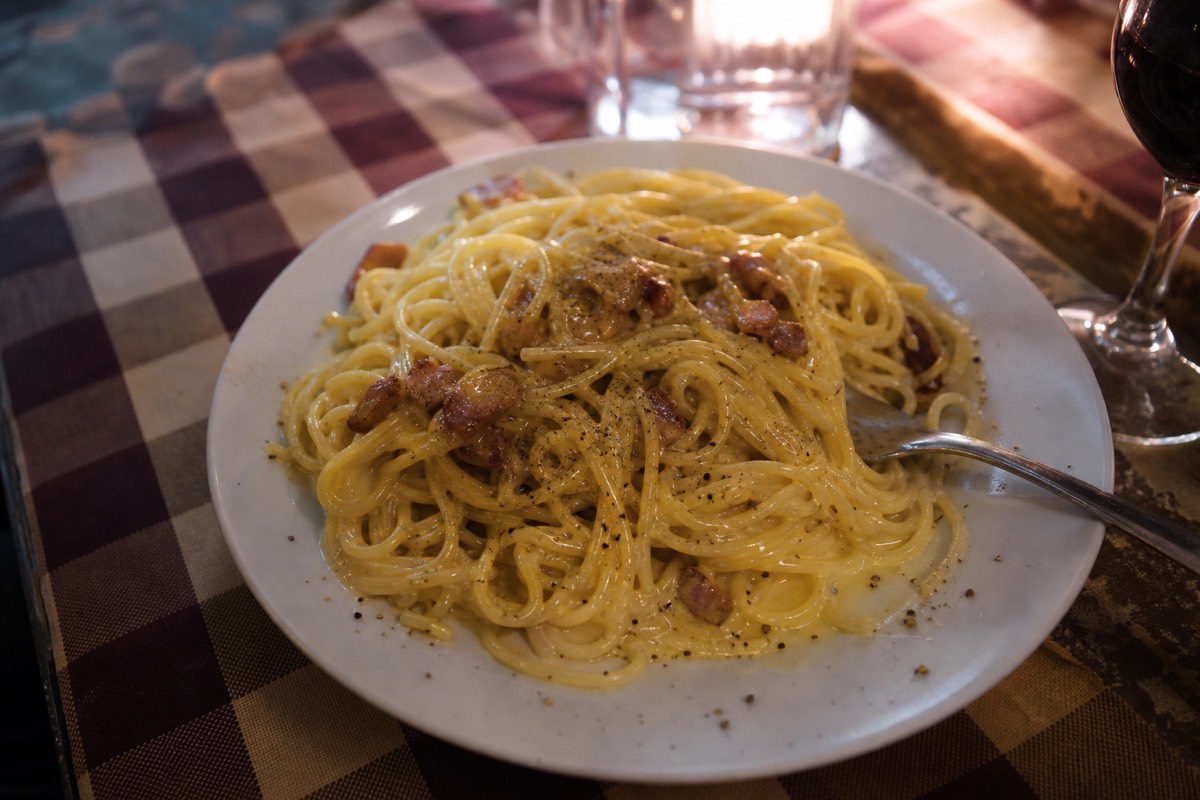
The four Roman pastas, built from one idea
Every classic Roman pasta is a step away from the last, which is why the ingredients repeat.
What Food Is Rome Famous For?
Rome is famous for a handful of pecorino-and-pork pasta dishes, for fried street food like supplì and pizza al taglio, for Roman-Jewish artichokes, and for a sweet cream-filled bun called the maritozzo, all rooted in a frugal peasant and offal cooking tradition rather than the creamy "Italian" food served abroad. Cucina romana is bold, salty and simple, built on a short list of ingredients used well.
The backbone is four things: pecorino romano, the hard sheep's-milk cheese that gives Roman pasta its salt and tang; guanciale, cured pork jowl that renders into something richer and deeper than bacon; black pepper; and eggs. Nearly every dish you will read about below is some combination of those, plus tomato when it appears at all. Once you see the pattern, the menu stops being a mystery.
The other thing to know is that the real canon is narrow and repeats across the city, which is a feature, not a lack of imagination. A good Roman kitchen makes the same ten or twelve dishes its grandmother made, and makes them precisely. If you are also mapping out things to do in Rome, plan your meals with the same care you give the monuments, because a badly chosen lunch beside a famous fountain will teach you less about the city than a plate of cacio e pepe in a back-street trattoria.
| Dish | What it is | Best thought of as |
|---|---|---|
| Cacio e pepe | Pasta with pecorino and black pepper | Rome's three-ingredient masterpiece |
| Carbonara | Egg, pecorino, guanciale, pepper | The dish most often ruined abroad with cream |
| Amatriciana | Guanciale, tomato, pecorino | The one red-sauce Roman pasta |
| Supplì | Fried rice croquette with a molten centre | The essential Roman street snack |
| Carciofi | Artichokes, braised or deep-fried | A spring specialty, and a Roman-Jewish classic |
| Maritozzo | Sweet bun split and filled with cream | Breakfast, or an excuse for a second coffee |
What Are The Four Classic Roman Pastas?
The four pillars of Roman pasta are cacio e pepe, gricia, amatriciana and carbonara, and they are really variations on one idea: pecorino romano and, in three of them, guanciale, built up step by step from the plainest version to the richest. Learn the family and you can order confidently anywhere in the city.
Start with cacio e pepe, pasta tossed with pecorino and black pepper into a glossy sauce, no fat and no meat, just cheese, starchy water and technique. Add guanciale to that and you get gricia, the "white amatriciana" and the oldest of the four. Add tomato to gricia and you arrive at amatriciana, which took its name from the town of Amatrice and is the only one of the four with a red sauce. Take a different fork from gricia, drop the tomato and bind it with raw egg and more pecorino off the heat, and you have carbonara.
The rules Romans care about are worth respecting because they are the whole point. Carbonara has no cream, ever; the silk comes from egg and cheese emulsified with pasta water. Guanciale is not pancetta and definitely not bacon. Pecorino, not parmesan, does the seasoning. The classic shapes are tonnarelli or spaghetti for cacio e pepe and carbonara, rigatoni or bucatini for the guanciale-and-tomato pair. If you only try one thing on a short trip, the pastas are what not to miss in Rome on a plate.
| Pasta | Core ingredients | The rule |
|---|---|---|
| Cacio e pepe | Pecorino, black pepper, pasta water | No cream, no butter; it is an emulsion |
| Gricia | Guanciale, pecorino, pepper | Amatriciana without the tomato |
| Amatriciana | Guanciale, tomato, pecorino | The only red-sauce Roman pasta |
| Carbonara | Egg, guanciale, pecorino, pepper | Raw egg off the heat; never cream |
What Street Food Should You Try In Rome?
The Roman street-food essentials are supplì, pizza al taglio sold by weight, plain pizza bianca, the sandwich-in-a-pizza-pocket trapizzino, and fried filetti di baccalà, all cheap, fast and made for eating on your feet between sights. This is how Romans actually eat much of the time, standing at a counter, not sitting for three courses.
Supplì is the one to start with: an oval croquette of risotto-style rice and ragù, crumbed and fried, with a core of mozzarella that pulls into a long string when you bite it, which is why the classic is nicknamed supplì al telefono. It is a cousin of the Sicilian arancino but its own Roman thing. Pizza al taglio is rectangular pizza baked in trays and sold by weight; you point at what you want, the server cuts a piece and weighs it, and you pay by the etto, the hundred grams. Pizza bianca, the same dough with just oil and salt, is a bakery staple often split and filled with mortadella.
Two more reward a detour. The trapizzino, a triangular pocket of pizza dough stuffed with slow-cooked fillings like chicken cacciatora or oxtail, is a modern Roman invention that has spread across the city. Filetti di baccalà, deep-fried salt-cod fillets in a light batter, are a Jewish-Roman tradition best eaten in the old Ghetto. Trastevere and the Testaccio market are two of the best areas to graze, and if you are still weighing where to stay in Rome, being near either one puts good, cheap food at your door.
| Street food | What it is | How to order it |
|---|---|---|
| Supplì | Fried rice croquette, mozzarella centre | Grab one hot from a fry counter or pizzeria |
| Pizza al taglio | Tray-baked pizza sold by weight | Point, and let them cut and weigh a piece |
| Pizza bianca | Oiled, salted flatbread | Plain, or split and filled at a bakery |
| Trapizzino | Dough pocket with a stewed filling | Pick a filling; eat it standing |
| Filetti di baccalà | Battered, fried salt cod | Best in the Jewish Ghetto |
What About Artichokes, And The Other Roman Specialties?
Beyond pasta, the Roman table runs on artichokes done two famous ways, on saltimbocca, on nose-to-tail dishes like oxtail and tripe, on spring lamb, and on vegetable plates such as puntarelle and fried zucchini flowers, most of them tied to a season. This is where you eat past the greatest hits into the real cooking of the city.
The artichoke, carciofo, gets two treatments worth seeking out. Carciofo alla romana is trimmed flat, stuffed with mint and garlic and braised in oil until tender. Carciofo alla giudia is a Jewish-Roman classic, the whole artichoke fried twice until the leaves open into a crisp bronze flower; you eat it in the Ghetto, and it is glorious. Both belong to the Roman winter-into-spring, roughly February to April, when the local Romanesco artichoke is in season. Order out of season and you are eating an import.
The meat and offal dishes tell you the most about where cucina romana comes from. Saltimbocca alla romana is veal layered with prosciutto and sage. Coda alla vaccinara, oxtail braised slowly with celery and tomato, and trippa alla romana, tripe in tomato and mint, are the old "quinto quarto" cooking of the Testaccio slaughterhouse district, where workers were paid in offal. Abbacchio, milk-fed lamb, appears especially around Easter. On the vegetable side, look for puntarelle, a bitter chicory salad dressed with anchovy and garlic that shows up in winter, and fiori di zucca, zucchini flowers stuffed with mozzarella and anchovy and fried. Knowing the season is half of eating well here, which ties neatly to the best time to visit Rome for the food you want.
| Dish | What it is | When it is at its best |
|---|---|---|
| Carciofo alla romana | Braised, mint-stuffed artichoke | Late winter into spring |
| Carciofo alla giudia | Twice-fried whole artichoke, Jewish-Roman | Late winter into spring; eaten in the Ghetto |
| Saltimbocca alla romana | Veal with prosciutto and sage | Year round |
| Coda alla vaccinara | Slow-braised oxtail | Year round, a cold-weather favourite |
| Trippa alla romana | Tripe in tomato and mint | Traditionally a Saturday dish |
| Puntarelle | Chicory salad, anchovy dressing | Winter |
Where Is Gelato Done Well, And What Do You Eat For Breakfast?
Good gelato is easy to spot once you know the tells: muted natural colours, flavours kept in covered steel tins rather than piled in bright fluffy mountains, and a pistachio that looks dull green-brown rather than neon. The best gelaterie make small batches daily and hide nothing behind decoration.
The bright, whipped, towering displays near the big sights are the ones to walk past; that height and colour come from air, stabilisers and dyes. Banana that is pale grey-yellow is a good sign, because real banana oxidises; banana the colour of a highlighter is not. Look for the word artigianale, ask what is made in house, and trust a short menu of natural flavours over a rainbow of forty. A small cone or cup of two flavours usually runs a few euros, and you should get a taste of the season, fig in autumn, wild strawberry in early summer.
For breakfast, Romans keep it light and sweet, which surprises visitors expecting a big spread. The classic is a cornetto, the softer Italian cousin of the croissant, with an espresso or cappuccino, taken standing at the bar. The great Roman treat is the maritozzo, a soft sweet bun sliced open and packed with unsweetened whipped cream, eaten in the morning with coffee. Hotel breakfasts aside, this is the local way to start a day of walking, and it pairs perfectly with an early stroll before the crowds arrive.
When Do Romans Actually Eat, And How Does Coffee Work?
Romans eat lunch from about 1pm to 2:30pm and rarely sit down to dinner before 8pm, with most kitchens opening around 7:30pm; coffee is standing-at-the-bar quick, cappuccino belongs to the morning, and an espresso follows a meal. Turn up for dinner at 6:30pm and you will find half-empty rooms and kitchens still warming up.
The rhythm runs like this. Breakfast is small and early. Lunch is the midday anchor, and many traditional places close in the afternoon before reopening for dinner. Aperitivo, a drink with a few snacks, fills the early evening from roughly 6pm to 8pm. Dinner is late and long. Booking ahead for a popular trattoria matters more at 8:30pm on a weekend than at almost any other time.
Coffee has its own etiquette, though none of it is enforced with any real seriousness. Ordering a cappuccino after lunch will not get you scolded, but you will notice locals take theirs only in the morning and switch to espresso, or a macchiato, later in the day. The bigger money-saver is where you stand: a coffee taken al banco, standing at the bar, is cheaper, often around a euro to a euro fifty for an espresso, while sitting at a table, al tavolo, adds a service charge. Pay at the till first in many bars, then take your receipt to the counter.
| Meal | Typical Roman timing | What it looks like |
|---|---|---|
| Breakfast | Early, brief | Cornetto or maritozzo with coffee, standing |
| Lunch | 1pm to 2:30pm | The main midday sit-down meal |
| Aperitivo | 6pm to 8pm | A drink with olives, chips or small bites |
| Dinner | From 8pm | Late, unhurried, often booked ahead |
Where Should You Eat, And How Do You Spot A Good Trattoria?
The best Roman eating is in the old food neighbourhoods, Testaccio, Trastevere, the Jewish Ghetto and Monti, and you spot a good trattoria by its short handwritten menu of Roman dishes, a room full of locals, and the absence of photo menus or a host waving you in from the street. Location and these few tells matter more than any single famous name.
Testaccio is the heart of it, the old slaughterhouse district where the offal cooking was born, and its covered market is one of the best places in the city to eat cheaply and well. Trastevere is the classic evening choice, cobbled and lively, though the lanes closest to the main piazza tip into tourist prices, so wander a few streets out. The Ghetto is where you go for the fried artichoke and Roman-Jewish cooking, and Monti, just above the Colosseum, hides good small trattorias among its boutiques. Markets are worth building a morning around too: Campo de' Fiori, the Testaccio Market and Mercato Centrale near Termini all reward a graze. Choosing where to stay in Rome near one of these puts real food within a short walk of your bed.
The signs of a good kitchen are consistent. A menu that is short, seasonal and handwritten, or recited by the waiter, beats a laminated book that runs to forty dishes and four languages. Look for the Roman canon done plainly, cacio e pepe, coda alla vaccinara, carciofi in season, rather than a pan-Italian greatest-hits list. A dining room with Roman families and older regulars is the strongest signal of all, and a place that needs a photo of the food or a tout at the door to fill its tables is telling you it cannot fill them on cooking alone.
| Neighbourhood | Known for | Order this |
|---|---|---|
| Testaccio | Offal cooking, the market, working-class Rome | Coda alla vaccinara or trippa alla romana |
| Trastevere | Cobbled evening dining and bars | Cacio e pepe, a few streets off the main piazza |
| Jewish Ghetto | Roman-Jewish tradition | Carciofo alla giudia and filetti di baccalà |
| Monti | Small trattorias near the Colosseum | Whatever is handwritten and in season |
What Is Coperto, And How Does Paying Work?
Coperto means a cover charge, but Rome is in Lazio, where regional law prohibits adding a separate coperto charge. A disclosed table-service charge is different, and tipping remains optional. Understanding this one line on the bill saves the most confusion.
A separate coperto charge is prohibited in Lazio. A servizio is different: any table-service component must be shown clearly in the price list before you order, and it is not a voluntary tip. If service was good you might round up or leave a euro or two per person, and on a larger or more special meal a little more, but there is no expectation of a 15 or 20 percent addition. Our fuller take on this sits in the guide to tipping in Rome, which is worth a read before your first dinner.
Two habits keep the bill honest. Read the menu, including any disclosed service component and per-weight fish or steak prices, before you order, since a place that hides prices is telling you something. And be alert near the very biggest sights, where a table with a fountain view and no printed prices is one of the classic tourist mistakes to avoid in Italy. Tap water is safe across Rome, from the taps and from the little street fountains called nasoni, though restaurants will bring bottled unless you are specific. A food-focused day in Trastevere or Testaccio is easy to fold into a bigger trip. Leave time between sightseeing and meals so you can choose where to eat before you are tired and hungry.
| On the bill | What it means | Do you pay it? |
|---|---|---|
| Coperto | A separate cover charge | Prohibited in Lazio, including Rome |
| Servizio | A service percentage, when added | Yes, if disclosed; then no separate tip needed |
| Mancia (tip) | A voluntary thank-you | Optional; round up or a euro or two |
| Acqua | Bottled water, unless you ask for tap | Yes; tap water is safe and free |