Day Trips From Rome: The Complete Guide
Rome sits inside easy reach of an ancient port, hill towns crowned by cathedrals, a city buried by a volcano, and two of Italy's great art capitals. This guide sorts every day trip by how far it really is, how you actually get there, and how much of it you can see before the last train home.
Day trips from Rome, by distance and time
Distances are by road; times are the fastest reliable one-way rail service. The far southern and northern trips are full days, not afternoons.
What Are The Best Day Trips From Rome?
The strongest day trips from Rome fall into three rings: half-day sites within an hour such as Ostia Antica, Tivoli and the Castelli Romani wine towns; hill towns around ninety minutes out like Orvieto; and the long-haul stars, Naples, Pompeii, Florence and the Amalfi Coast, each of which eats a committed full day. Which ones earn a slot depends less on the place and more on the clock. A trip that spends two hours each way still leaves a good six on the ground; one that spends six hours travelling leaves you time for a single village and a plate of pasta.
Our team fields the same question from almost every traveler who books a Rome trip: what can we add on the side. The honest answer starts with distance. The table below lays out the eight options people ask about most, ordered from the closest half-day escapes to the ambitious runs south and north. Times are one-way and reflect the fastest reliable service, not the cheapest slow train.
| Destination | Distance from Rome | Fastest one-way transit | Why go |
|---|---|---|---|
| Ostia Antica | about 30 km | 35-45 min on the Roma-Lido regional line | Rome's own ancient port, nearly as complete as Pompeii and far quieter |
| Tivoli and Villa d'Este | about 30 km | 1 hour by regional train | Renaissance water gardens plus Hadrian's Villa, two UNESCO sites in one valley |
| Castelli Romani | about 20 km | 30-40 min by regional train | Frascati wine, papal Castel Gandolfo and Lake Albano in the hills |
| Orvieto | about 120 km | 1 hr 10-20 min by train, then the funicular | A golden-stone Umbrian hill town under one of Italy's finest cathedrals |
| Naples | about 225 km | 1 hr 10 min by high-speed train | Pizza's birthplace and the museum that holds Pompeii's real treasures |
| Pompeii | about 240 km | ~2 hours: high-speed to Naples, then the Circumvesuviana | The city stopped mid-life by Vesuvius in AD 79 |
| Florence | about 275 km | 1 hr 30 min by high-speed train | The Renaissance capital: the Duomo, the Uffizi, Michelangelo's David |
| Amalfi Coast | about 270 km | 2 hrs by train to Salerno, then a ferry | Cliffside Positano and Ravello, the hardest of these to fit into a day |
Read that table as a filter, not a bucket list. If you only have three or four days in Rome, the close-in ring is your friend; the far runs make more sense once you have a week. We come back to that trade-off at the end.
Which Day Trips Can You Reach By Train From Rome?
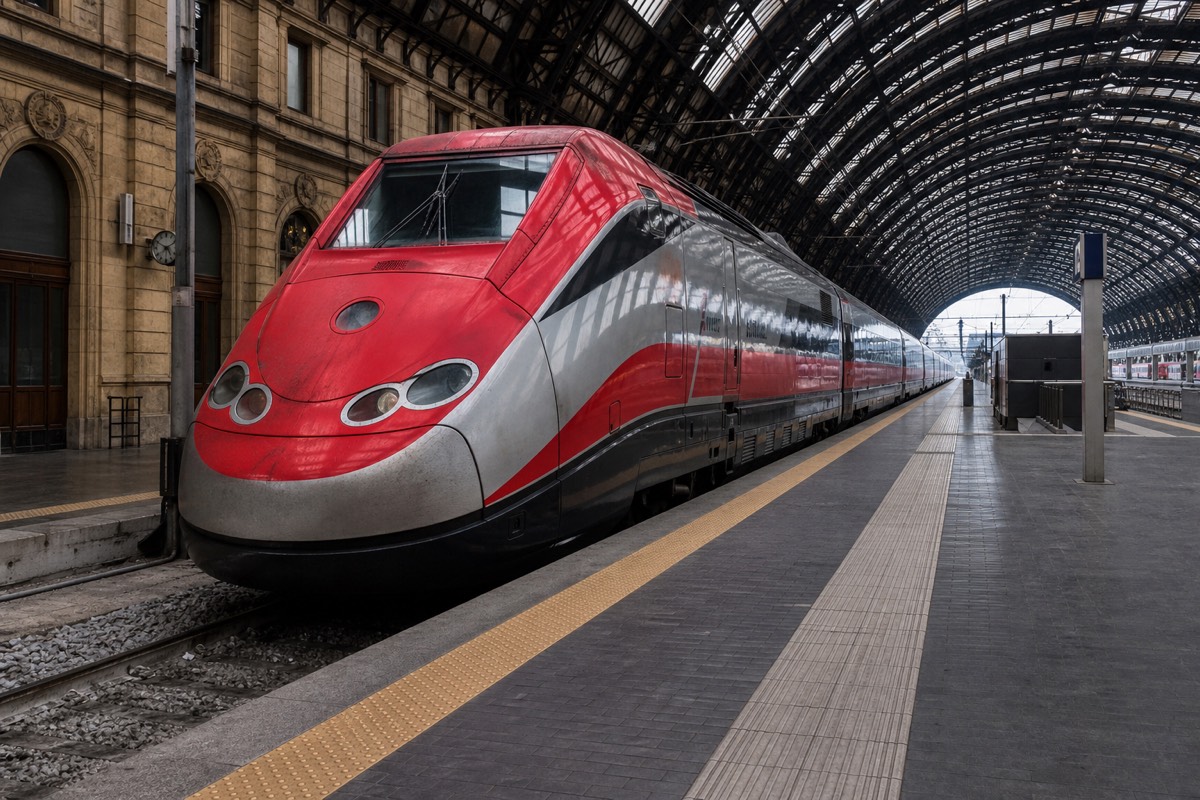
Most of the best day trips from Rome are train trips, because Rome sits on the spine of Italy's high-speed network and inside a dense web of regional lines from Termini, Tiburtina and Porta San Paolo. High-speed Frecciarossa and Italo services fan out north to Florence and south to Naples and Salerno, while slower regional trains handle Ostia Antica, Tivoli, Frascati and Orvieto for a few euros each way.
The split matters for planning. High-speed seats are reserved and priced like flights: book them early through Trenitalia or the operator's own site and a Rome to Naples run can cost a fraction of the walk-up fare. Regional trains are not reserved, so you can turn up and buy a ticket, but they are slower and stop everywhere. For the far destinations, the earliest fast train out and a mid-evening train back are what turn a rushed dash into a real day.
| Destination | Station or line from Rome | One-way time | Fare guidance |
|---|---|---|---|
| Ostia Antica | Roma-Lido line from Porta San Paolo (Piramide) | 35-45 min | Covered by a standard urban transit ticket, around EUR 1.50 |
| Tivoli | Regional train from Termini or Tiburtina | ~1 hour | A few euros each way, check Trenitalia |
| Frascati (Castelli Romani) | Regional train from Termini | 30-40 min | A few euros each way |
| Orvieto | Regional or Intercity from Termini | 1 hr 10-20 min | A modest regional fare, check the live price |
| Naples | Frecciarossa or Italo high-speed | ~1 hr 10 min | Often from around EUR 20-30 booked early, more last-minute |
| Florence | Frecciarossa or Italo high-speed | ~1 hr 30 min | Similar high-speed range, cheaper the earlier you book |
| Salerno (for the Amalfi Coast) | Frecciarossa or Italo high-speed | ~2 hours | High-speed fare, check the live listing |
One practical point on the airport. If you land at Fiumicino and want to launch a day trip straight away, the Leonardo Express feeds you into Termini in about 32 minutes, and every high-speed line starts there. More on that in our guide to getting around Rome, which covers the airport transfers and the metro in detail.
Buying tickets splits the same way as the trains do. High-speed fares are dynamic, so the seat you reserve six weeks out can cost less than half the walk-up price on the day; set an alert and grab it early. Regional tickets to Ostia, Tivoli, Frascati and Orvieto are fixed-price and sold on the day at machines or the counter, and paper tickets require validation before boarding; Trenitalia digital regional tickets activate automatically at the scheduled departure. If the far runs are your plan, a broad rail pass rarely beats a couple of cheap advance fares, so price the exact trains you need before buying anything wider.
The Half-Day Classics: Ostia Antica, Tivoli And The Castelli Romani
Ostia Antica, Tivoli and the Castelli Romani are the three escapes you can do in half a day and still be back for dinner in Rome, which makes them ideal when you only have three or four days and do not want to lose a full one. Each sits inside an hour of the centre, and each answers a different mood: ruins, gardens, or wine and lake views.
Ostia Antica is the quiet surprise. It was Rome's seaport for centuries, and because the coastline silted up and moved, the town was abandoned rather than built over. What survives is a full Roman street plan: a theatre you can climb, an old forum, apartment blocks, baths with intact floor mosaics, even the marble counters of ancient bars. It reads like Pompeii without the crowds or the four-hour journey, and the Roma-Lido line drops you a short walk from the gate.
Tivoli packs two UNESCO sites into one valley. Villa d'Este is a hillside of Renaissance fountains, the kind of terraced water garden that inspired half of Europe, and Hadrian's Villa a few kilometres away is the sprawling country estate of an emperor. Doing both in one visit is a full day; picking one leaves the afternoon free. The Castelli Romani, the volcanic hills just south, are the least touristy of the three: Frascati for white wine straight from the barrel, Castel Gandolfo for the papal gardens and Lake Albano below.
| Site | What you see | Time on site | Ticket |
|---|---|---|---|
| Ostia Antica | Theatre, forum, mosaics, Roman apartment blocks and bars | 2.5-3 hours | Around EUR 18, check the official site |
| Villa d'Este, Tivoli | Terraced Renaissance gardens and hundreds of fountains | 1.5-2 hours | Around EUR 15, check the official site |
| Hadrian's Villa, Tivoli | The vast ruins of an emperor's country estate | ~2 hours | Around EUR 12, check the official site |
| Castelli Romani (Frascati) | Wine cellars, Castel Gandolfo gardens, lake views | Half a day | Varies by site, mostly modest or free |
Orvieto And The Hill Towns Of Umbria And Tuscany
Orvieto is the best of the middle-distance hill towns from Rome: roughly ninety minutes by train, capped by a striped Gothic cathedral, and small enough to see properly in an afternoon. It sits on a plug of volcanic rock, so the train leaves you at the foot and a short funicular carries you up into a town that has barely changed shape in five centuries.
The Duomo is the draw. Its facade is a mosaic-and-marble showpiece, and inside, the San Brizio chapel holds a fresco cycle of the end of the world that Michelangelo is said to have studied before the Sistine ceiling. Beyond the cathedral, Orvieto is caves, a stepwell called the Pozzo di San Patrizio, crisp white wine, and lanes that empty out the moment the coach crowds leave. It rewards a slow lunch.
Getting there is painless. Regional and Intercity trains leave Roma Termini through the day, the ride is a little over an hour, and the funicular from the station up to the old town is quick and cheap. Because Orvieto sits on the main Rome-Florence line, it also makes a natural half-day break if you are heading north anyway. A combined ticket that bundles the funicular, the Duomo and the underground caves saves queuing twice, and the tourist office by the top station hands out a map that keeps the lanes from turning into a maze.
Two other hill towns come up in the same breath, and both are honestly a stretch as day trips. Assisi, the town of Saint Francis, is around two hours out and doable if you commit the whole day to it. Siena, with its shell-shaped Piazza del Campo, sits closer to three hours each way and has no fast direct train, so it works far better as a stop on a Tuscany route than as a return trip from Rome. If Tuscan hill towns are the real goal, a multi-city plan beats bouncing back to Rome each night. We map those routes in our Italy itinerary guide.
Pompeii And Naples: The Great Archaeological Day South
Pompeii and Naples make one of the most rewarding long day trips from Rome, but it is a genuine full day: about an hour and ten minutes to Naples by fast train, followed by the transfer and local journey to the ruins, and the same distance back. Done well it is unforgettable. Done in a panic, chasing the last connection, it can feel like a lot of train for a hurried walk through the site.
The mechanics are simple once you know them. A Frecciarossa or Italo gets you to Napoli Centrale in about an hour and ten minutes. From there the Circumvesuviana commuter line, or the more comfortable Campania Express, runs out to the Pompei Scavi stop right beside the entrance in another thirty-five to forty minutes. Pompeii itself is enormous, one of the largest archaeological sites in the world, and you want three to four hours inside to do more than skim it. That is why we gave the route its own deep dive: our full Pompeii day trip guide walks through the timings, the on-site route and whether to take a guide.
The change at Naples is the part first-timers worry about, and it is easier than it reads. You come off the high-speed train at Napoli Centrale and follow the signs down to the Circumvesuviana, an older commuter line that runs out past the ruins toward Sorrento. Keep your bag in front of you on the busier trains and you are at the Pompei Scavi gate inside forty minutes. If the ruins feel like a lot of travel for the hours on site, Herculaneum, the smaller and far better preserved town on the same line, is the quieter alternative.
Naples on its own is a different day and a great one. The Archaeological Museum holds the frescoes, mosaics and bronzes lifted out of Pompeii and Herculaneum for safekeeping, so pairing a morning in Naples with the ruins gives you both the city and its treasures. Trying to cram Pompeii, Vesuvius and Naples into a single day from Rome is where people come unstuck; two of the three is the sensible cap. The table below shows what a day actually leaves you on the ground once the trains are subtracted.
| Destination | Round-trip transit from Rome | Realistic hours on site in a day |
|---|---|---|
| Naples | ~2.5 hours | 6-7 hours |
| Pompeii | ~4 hours | 3-4 hours |
| Florence | ~3 hours | 6-7 hours |
| Amalfi Coast | 5-6 hours or more | 3-4 hours, one or two villages |
The Amalfi Coast In A Day: Possible, But The Tightest Option
You can reach the Amalfi Coast from Rome and back in a single day, but it is the most demanding trip in this guide and only works in ferry season, when a high-speed train to Salerno connects with a boat along the cliffs. Expect five to six hours of travel for three or four hours in Positano or Amalfi, and expect to make peace with seeing one village rather than the whole coast.
The reason it is hard is geography. The famous corniche road is slow and winding, buses crawl, and the coast has no station of its own. The cleanest approach is the train to Salerno, then a Travelmar or Alicost ferry that reaches Amalfi in about thirty-five minutes and Positano in a little over an hour. That only exists from roughly Easter to early November; outside those months the ferries thin out or stop, and a day trip becomes a long, tiring drive. Because so many people ask us how to reach the Amalfi Coast without a car, we built a separate transport guide that compares every route in full: see Rome to the Amalfi Coast.
Timing is everything on this run. The last useful ferry back toward Salerno can leave in the middle of the afternoon in the shoulder months, and missing it can strand you on a slow bus over the pass. Check the boat schedule for your exact date, aim for the first fast train south, and treat the day as one village done properly rather than the whole coast skimmed. Get those three things right and it is a wonderful day out; get them wrong and it is a cautionary tale.
Our honest steer is that this stretch of coast repays an overnight more than almost anywhere in Italy. A single night in Sorrento or Positano turns the frantic day into a relaxed two, and it lets you catch the coast in its best light, early morning and late afternoon, when the day-trippers have gone. The table below is the blunt version of that advice.
| Destination | Works as a day trip from Rome? | Better with a night? |
|---|---|---|
| Pompeii | Yes, a long but doable day | Pairs well with a Naples or Sorrento overnight |
| Naples | Yes | A night lets you add Pompeii or Herculaneum |
| Florence | Yes, on the first fast train out | A night opens the Uffizi and Accademia without the rush |
| Amalfi Coast | Only just, and only in ferry season | Almost always better as one or two nights on the coast |
| Venice | Not really, not from Rome in a day | Needs at least one overnight |
Florence, And Could You Fit Venice?
Florence is the one far city that works cleanly as a day trip from Rome, at roughly ninety minutes each way by fast train, while Venice at nearly four hours each way is a stretch that leaves too little time on the ground. Take the first Frecciarossa north and you are standing under the Duomo before the day-trip crowds, with six or seven hours to spend before an evening train home.
A Florence day has a natural shape. The historic centre is compact and walkable, so you can see the Duomo and Baptistery, cross the Ponte Vecchio, and stand in Piazza della Signoria without hurrying. The two things that need pre-booked timed tickets are the Uffizi and the Accademia, home to Michelangelo's David; reserve those before you leave Rome or you will lose an hour in line. Climbing Brunelleschi's dome also needs a separate timed slot.
The tactic that makes a Florence day work is the early train. Take one of the first departures north and you reach the city before the coach tours, which gives you the Duomo square and the Ponte Vecchio in relative calm, a proper lunch in the centre, and a museum in the afternoon before the ride home. Skip that head start and you spend the best light of the day standing in a ticket queue instead of under Brunelleschi's dome.
Venice is the harder call. It is genuinely beautiful and genuinely far, and a same-day return gives you maybe three hours between the crowds around St Mark's. If Venice matters to you, it deserves a night, or a place on a north-bound route rather than a round trip from Rome. We break down the distances, the fastest trains and whether the return dash is worth it in our guide to Rome to Florence and Venice.
| Factor | Florence | Venice |
|---|---|---|
| Distance from Rome | ~275 km | ~530 km |
| Fast train, one way | ~1 hr 30 min | ~3 hr 45 min to 4 hr 15 min |
| Time on the ground in a day | 6-7 hours | 3-4 hours at most |
| Day-trip verdict | Comfortable | Rushed, far better as an overnight |
How To Choose Your Day Trips, And When A Package Beats Them
Match your day trips to how long you are in Rome: with three days, stay close or skip them; with five, add one full day; with a week or more, a coastal overnight or a Florence run finally makes sense. The most common mistake we see is a first-timer with four days trying to fit Rome, Pompeii and the Amalfi Coast, then spending the trip on trains instead of in Italy.
Start from the number of nights you actually have. If you are still deciding, our guide on how many days in Rome walks through it, and the things to do in Rome guide covers what the city itself needs before you start looking outward. The rule of thumb below has saved a lot of travelers a lot of wasted mornings.
| Days in Rome | Day trips that fit comfortably | Leave for another trip |
|---|---|---|
| 3 days | None, or a half-day to Ostia or Tivoli if you steal a fourth | The far southern and northern runs |
| 4-5 days | One full day: Pompeii and Naples, or Florence | Trying to fit both coasts |
| 6-7 days | Two day trips, or a night based on the coast | Same-day Venice |
| 8+ days | Pompeii plus an Amalfi overnight, and a Florence day | Nothing, this is the sweet spot |
There is also a point where the do-it-yourself day trip stops being the smart move. The Amalfi Coast and Pompeii both involve train changes, ferry seasons and timed entries, and when they are the whole reason for the trip, letting an operator handle the transfers, the tickets and the hotels usually beats a self-planned dash. The team at Rome Tour Packages books these longer runs as part of multi-day trips most weeks, which is why the Amalfi Coast, Pompeii and the classic Rome-Florence-Venice loop sit inside our packages rather than as bolt-on days. If you are weighing a week that takes in the big three Italian cities, the question of whether seven days is enough to see Italy is worth reading before you book anything.
One last factor decides how many day trips to attempt: energy. These are tiring days, and stacking three long ones onto a week in Rome can leave you having seen everything and enjoyed little. Space them out, keep at least one slow day in the city with no train to catch, and let the trip breathe. The best-planned Rome weeks we see treat a day trip or two as highlights, not a checklist to grind through before the flight home.
Whichever way you go, plan the day trips around the trains, not the other way round, and check the best time to visit Rome so you are not fighting August heat or a closed ferry timetable. Get the timing right and the countryside, coast and rival art cities around Rome turn a good trip into a memorable one.