Is Rome Safe? Safety Tips & Common Scams
Ask a Roman what really goes wrong for visitors and they will not mention danger. They will mime a hand slipping into a bag. Rome is a warm, walkable, heavily policed city where the odds of harm are low and the odds of losing a phone in a crowd are the thing actually worth planning around.
Spot the scam: a quick reference
The street scams visitors meet most in Rome, and the one-line response that ends each.
Is Rome Safe For Tourists?
Rome is a safe city for visitors, with violent crime rare by the standard of most large capitals; the genuine risk is non-violent theft, above all pickpocketing in tourist crowds and on a few notorious bus and metro lines, plus a short list of street scams aimed at visitors rather than residents. Tens of millions of people pass through the historic centre each year, and the large majority go home with nothing worse than sore feet. What does happen, often enough to prepare for, is a wallet or phone lifted in a press of bodies.
That distinction changes what you actually do on the ground. Protecting belongings is an important part of planning, alongside ordinary personal-safety precautions. A pickpocket wants a clean lift and a quiet exit, not a confrontation, so the whole trade runs on distraction: a bumped shoulder, a dropped map, a baby held out toward you, a sudden scrum at a train door. Keeping valuables secure reduces opportunity, but theft can still happen.
Rome also carries a heavy, visible police presence around its landmarks. You will see Carabinieri, Polizia di Stato and Guardia di Finanza near the Colosseum, around the Vatican and across the main piazzas, with seasonal tourist-assistance points as well. None of that stops a practised hand on a packed bus, but it means the streets are well watched and that reporting a theft is quick and routine.
| Risk | How often visitors meet it | What it usually looks like |
|---|---|---|
| Violent crime against tourists | Uncommon | Remain aware of your surroundings; do not assume a tourist area removes all risk |
| Pickpocketing and bag-snatching | The main risk | A wallet or phone gone in a crowd, on a bus, or at a cafe table |
| Street scams | Common in tourist zones | Bracelets, clipboard petitions, unmetered taxis, gift-then-demand |
| Scams that turn threatening | Rare | Most scammers melt away the moment you refuse and keep walking |
Where Do Pickpockets Work In Rome?
Pickpockets concentrate wherever tourists stand still or pack tight: Roma Termini station, the crowded 64 and 40 bus routes toward the Vatican, Metro Line A, and the crush at the Colosseum, Trevi Fountain, Spanish Steps and St Peter's Square. The pattern is not random. Thieves go where people are distracted by a monument, loaded with bags, and jammed together so a hand at your pocket goes unnoticed.
Termini is the single busiest hunting ground, because it mixes tired arrivals, luggage and dense platforms. The 64 bus, which runs from Termini past Largo di Torre Argentina to St Peter's, is so well known for pickpockets that Romans joke about it, and the parallel 40 Express is no better. On Metro Line A, the stretch through Ottaviano near the Vatican, Spagna and Termini sees the most lifted wallets, usually right as the doors open and everyone shuffles at once. Learning your way around getting around Rome, and choosing quieter departure times, cuts your exposure more than any gadget.
The fix is posture, not paranoia. Wear a cross-body bag on your front with the zip toward you, keep a phone off the cafe table and out of a back pocket, and swing a backpack around to your chest whenever a space gets tight. If someone crowds you for no clear reason at a door or a ticket machine, treat it as a cue to put a hand on your bag, not as rudeness.
| Hotspot | Why thieves like it | The habit that beats it |
|---|---|---|
| Roma Termini and its buses | Luggage, tired arrivals, dense platforms | Bag in front, zipped; watch the moment you board |
| Bus 64 and 40 to the Vatican | Packed, tourist-heavy, slow stops | Consider the Rome metro to Ottaviano instead |
| Metro Line A doors | Everyone bunches as doors open | Hold your bag as you step on and off |
| Colosseum and Forum queues | People stare up, not down | Book a timed slot so you are not milling in the crowd |
| Trevi Fountain and Spanish Steps | Standing still, phones out for photos | Photograph, then move; do not linger with a phone loose |
What Are The Most Common Scams In Rome, And How Do You Avoid Them?
The scams that repeat in Rome are the friendship-bracelet tie-on, the costumed gladiator photo, the unmetered taxi, the clipboard petition, the gift-then-demand rose or trinket, and the overpriced tourist restaurant; each is easy to sidestep once you know the shape of it. Some encounters can become intimidating; move away and seek help if you feel threatened. They rely on politeness and hesitation, so a flat "no" and a steady walk defeat almost all of them.
The bracelet works near the Colosseum, the Spanish Steps and Ponte Sant'Angelo: a friendly man loops string around your wrist "as a gift", then demands cash once it is knotted on. Keep your hands in your pockets and do not let anyone touch you. The costumed centurions outside the Colosseum will happily pose, then insist on several euros per photo, so agree a price first or just take a wide shot from a distance. Rose sellers and the "found gold ring" both open with a gift and close with a hand out. The clipboard petition, often presented as a deaf-charity signature drive, is a double play: while you read, a partner works your bag.
Taxi overcharging is the one that costs the most. Use only the official white taxis from a marked rank and make sure the meter runs, or use the city's fixed airport fare, which is a posted, official rate: currently 55 euros from Fiumicino and 40 euros from Ciampino to the historic centre inside the Aurelian Walls, with the figure displayed at the rank. Ignore anyone who approaches you inside the terminal offering a "taxi", and confirm the posted fare before you get in. The same care over prices applies at the table, where a menu with no printed prices or a "special" fish sold by weight can produce a shocking bill, a trap worth knowing alongside the other tourist mistakes to avoid in Italy.
| Scam | How it works | How to shut it down |
|---|---|---|
| Friendship bracelet | String tied to your wrist "free", then payment demanded | Hands in pockets; do not let anyone touch you |
| Gladiator photo | Costumed figures pose, then charge per shot | Agree a price first or photograph from a distance |
| Unmetered taxi | Touts inside terminals quote a flat, inflated fare | Use marked white taxis or the posted fixed airport fare |
| Clipboard petition | You sign while an accomplice opens your bag | Keep walking; never stop to read a stranger's clipboard |
| Gift rose or ring | An object is pressed on you, then money is asked for | Refuse to take it; do not break stride |
| Tourist-menu overcharge | No printed prices, cover charges stacked, fish by weight | Read menu prices and any service charge before ordering; coperto is prohibited in Lazio |
Is Rome Safe At Night?
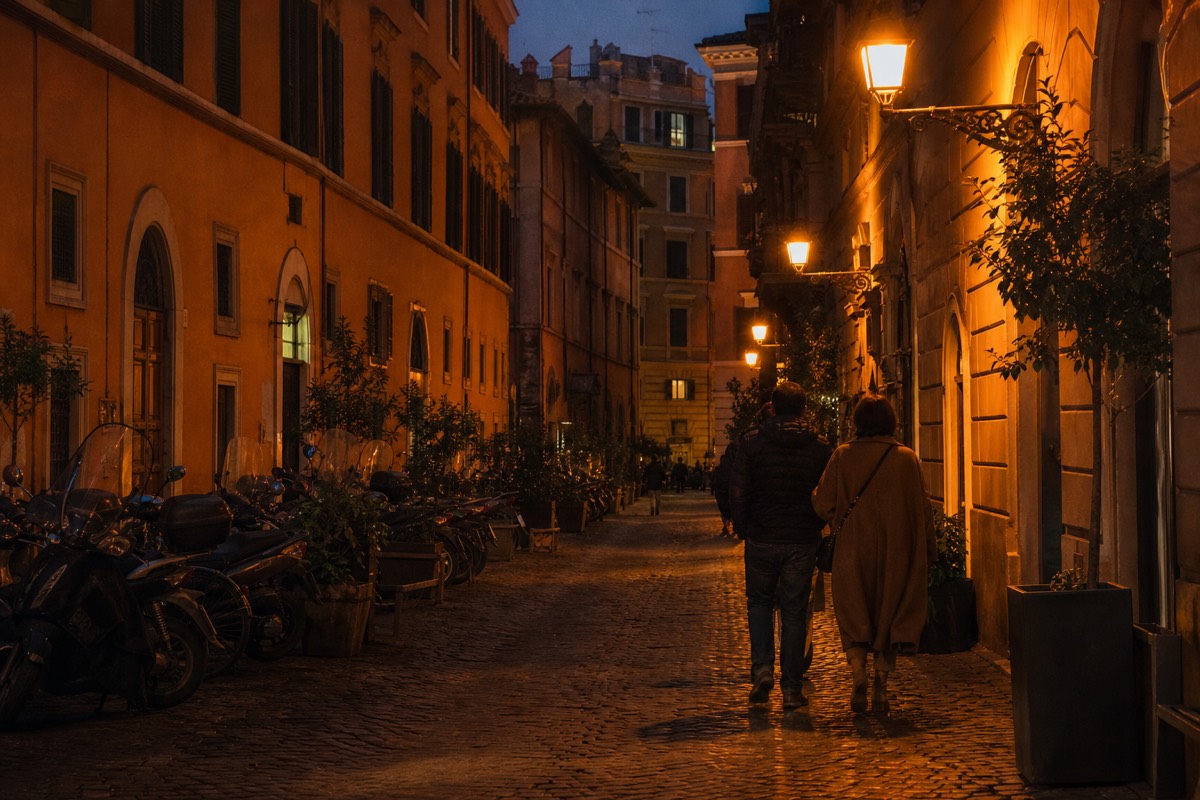
Many visitors walk in central Rome at night, but conditions vary: the historic core around the Pantheon, Piazza Navona and Trevi stays busy and well lit late, and Trastevere and Monti are lively rather than risky, while the streets immediately around Termini thin out after dark and warrant a bit more care. Evening is one of the best times to see the city, when the monuments are floodlit and the crowds ease.
The neighbourhoods where most visitors stay are the ones that stay awake. Trastevere fills with diners and bar-goers until well past midnight, so stay alert to your surroundings and belongings, especially around crowded bars. Monti, just up from the Colosseum, is calm and residential in the evening. The one area to treat with ordinary city sense is the ring of streets east and south of Termini, which empty out and feel rougher late at night; if you are staying near the station, take a licensed taxi back rather than wandering. Where to stay in Rome shapes how your evenings feel more than almost anything else.
Two simple rules cover the rest. Skip the large parks, Villa Borghese and Colle Oppio among them, once they are dark and empty. And if a stretch of street feels deserted and you are unsure, step back onto a lit main road with foot traffic; in central Rome one is never far away.
| Area | How it feels after dark | What to do |
|---|---|---|
| Historic centre (Pantheon, Navona, Trevi) | Busy, lit, safe late | Walk freely; keep your bag zipped in the crowd |
| Trastevere | Lively nightlife, safe | Enjoy it; watch belongings in packed bars |
| Monti | Calm, residential, safe | A relaxed choice for an evening stroll |
| Around Termini | Thin and rougher late | Take a licensed taxi; do not linger |
| Large parks after dark | Empty and unlit | Avoid; stick to streets with foot traffic |
Is Rome Safe For Solo And Female Travellers?
Rome is a comfortable city for solo travellers and for women travelling alone, with the same petty-theft caution that applies to everyone and the ordinary big-city street attention that can happen, though serious incidents against tourists are uncommon. Plenty of people visit Rome on their own and eat, wander and sightsee without trouble well into the evening.
Practical habits make it easier. Dress how you like, but keep valuables out of sight on transit and in crowds. Unwanted attention, a comment or a persistent street seller, is best met with the local response: no eye contact, no engagement, keep moving. When you take a taxi alone at night, use a marked white cab or a booking app so the ride is logged, and share your route with someone if it helps you relax.
Solo diners are entirely normal in Rome, and a licensed guide or a small-group day is a low-pressure way to meet people and cover ground without working out every route alone. If you want the reassurance of a set structure, a guided tour of Rome worth it for its logistics is often worth it for a solo traveller precisely because someone else is handling the queues, the timing and the route.
What Are The Emergency Numbers In Rome?
In Rome, and across Italy, 112 is the single emergency number: one call reaches an operator who dispatches police, an ambulance or the fire brigade, and English is available. If you prefer a specific service, 113 reaches the state police, 115 the fire brigade, 118 medical emergencies and an ambulance, and 1530 the coast guard, which matters if you extend the trip toward the Amalfi Coast.
For anything non-urgent, a pharmacy is your first stop. Look for the green cross; pharmacists handle minor ailments and can point you to a doctor, and several stay open at night on a rota posted in every farmacia window. To claim on travel insurance after a theft you need a police report, a denuncia, which you file at a Carabinieri or Polizia station; keep the copy they give you. A lost or stolen passport is a job for your embassy or consulate rather than the police.
| Number | Reaches | Use it for |
|---|---|---|
| 112 | Single emergency line | Any emergency; the operator routes your call |
| 113 | Polizia di Stato | Police, theft in progress, reporting a crime |
| 115 | Vigili del Fuoco | Fire and rescue |
| 118 | Medical emergency | Ambulance and urgent medical help |
| 1530 | Guardia Costiera | Trouble on or near the coast |
What About Rome's Traffic, Heat And Tap Water?
The everyday hazards in Rome are less about crime than about traffic, summer heat and footing: the traffic is fast and mopeds weave, July and August regularly push into the mid-30s Celsius, and the cobbles are uneven, but the tap water is clean and safe to drink, including from the street fountains. These are the things that actually send visitors home with a sore ankle or a bad afternoon, and all of them are manageable.
Crossing the street is a genuine skill here. Use marked crossings and traffic signals, check every lane and wait for vehicles to stop before stepping into the road. Watch for mopeds filtering between lanes, which do not always stop for a crossing the way a car will. On foot, the historic centre's basalt cobbles, the sampietrini, are beautiful and treacherous in smooth-soled shoes or after rain, so this is a city for broken-in shoes with grip rather than new soles or heels.
Heat is the summer risk that catches people out. Midday in July and August is brutal for a full walking day, so start early, break in the shade, and refill a bottle at the nasoni, the cast-iron street fountains that run cold, clean drinking water across the city. The tap water is safe throughout Rome, so there is no need to buy bottled beyond convenience. Pace a hot-weather visit the way a well-run guided day is paced, with an early start and a long lunch out of the sun, and adjust plans if conditions remain too hot. Planning around the best time to visit Rome is the simplest way to dodge the worst of it altogether.
| Everyday hazard | The reality | The habit that handles it |
|---|---|---|
| Traffic and mopeds | Fast, and scooters filter between lanes | Use marked crossings; wait for traffic to stop and watch for mopeds |
| Cobblestones | Uneven, slick when wet | Broken-in shoes with grip, not new soles or heels |
| Summer heat | Mid-30s Celsius in July and August | Early starts, shade breaks, refill at the nasoni |
| Tap water | Clean and safe citywide | Carry a refillable bottle; skip the plastic |
How Do You Keep A Rome Trip Trouble-Free?
Almost every problem visitors report in Rome comes down to two exposures, a bag left open in a crowd and an unofficial taxi, so a handful of plain habits can reduce opportunities for theft: carry a zipped cross-body bag worn in front, split your cash and cards, protect your passport and keep a separate copy, use marked taxis, and book timed entry so you are not stuck in queue-side crowds. Do those and you have covered the situations pickpockets and scammers actually rely on.
Think of it as reducing opportunity. Keep a copy of your passport and a spare card separate from the originals, so a theft is an inconvenience rather than a trip-ender. Book the big sights ahead through official Colosseum ticketing and the official Vatican Museums site, which both cuts the wait and keeps you out of the dense, distracted lines where wallets vanish. Rome's official tourism board publishes current visitor guidance if you want an authoritative source to check before you go.
Prebooking a transfer or timed visit can simplify arrival and sightseeing logistics. It does not guarantee personal safety or eliminate theft risk. Keep the same precautions whether you travel independently or join an organized trip.
| Habit | What it protects you from |
|---|---|
| Zipped cross-body bag worn in front | The classic crowd and bus-door pickpocket |
| Split cash and cards; copy of passport | Turns a theft into an inconvenience, not a crisis |
| Protect your passport; keep a separate copy | Losing the one document that is hard to replace |
| Marked white taxis or the fixed airport fare | The unmetered-taxi overcharge |
| Timed-entry tickets booked ahead | Standing distracted in the densest queues |