Pompeii Day Trip From Rome
Pompeii is about 240 km south of Rome, close enough to see and get home the same day, far enough that the day only works if you time the trains right. Here is the exact route via Naples, how long you really need in the ruins, and whether to take a guide.
A half-day walking route through Pompeii
A suggested order across the site, roughly west to east, so you cross Pompeii once rather than doubling back. The Villa of the Mysteries sits outside the walls if time and legs allow.
How Do You Visit Pompeii On A Day Trip From Rome?
To visit Pompeii from Rome in a day, take a high-speed train to Naples in about an hour and ten minutes, then change to the local Circumvesuviana line for a thirty-five to forty minute ride to the Pompei Scavi stop right beside the entrance. That two-leg route is the standard way, and once you know the change at Naples it is straightforward. The whole thing is a genuine full day, not an afternoon, so start early.
The first leg is the easy one: a Frecciarossa or Italo from Roma Termini drops you at Napoli Centrale, and it is worth booking that seat early through Trenitalia for the cheapest fare. The second leg is the one people fret about. At Naples you follow signs down to the Circumvesuviana, run by the regional operator EAV, and take a Sorrento-bound train to Pompei Scavi-Villa dei Misteri. It is an older, busier commuter line, so keep your bag close, but it works. In the warmer months the Campania Express runs the same route with fewer stops and reserved seats for a higher fare, a calmer alternative if you would rather not stand.
| Leg | Mode | Time | Fare guidance |
|---|---|---|---|
| Rome (Termini) to Naples (Centrale) | Frecciarossa or Italo high-speed | ~1 hr 10 min | Often EUR 20-40 booked early, check the live price |
| Naples to Pompei Scavi | Circumvesuviana commuter line (EAV) | ~35-40 min | A few euros each way, check the current fare |
| Naples to Pompei Scavi | Campania Express (warm season) | ~30 min | Reserved, higher fare, more comfortable |
| Alternative: mainline to modern Pompei | Regional Trenitalia train | ~30-40 min | Regional fare, arrives at the amphitheatre side |
One detail saves confusion at the gate. The ruins have two entrances: Porta Marina, next to the Pompei Scavi station, is where the Circumvesuviana leaves you and where most visitors start; the Piazza Anfiteatro gate, by the modern town and the mainline station, is quieter. Either works, but pick your return train to match the gate you exit.
Book the fast train as far ahead as you can. Rome to Naples is one of the busiest lines in Italy, and the advance fare can be a fraction of the walk-up price, so a seat reserved weeks out is money saved. The second leg does not need booking on the regular Circumvesuviana, you just buy a ticket and board, but the seasonal Campania Express does take a reservation, and it is worth it on a hot, crowded day when the local trains fill to standing.
How Long Does The Trip Take, And How Much Time Do You Get?
Allow time for both train legs, the change in Naples and the walk to the entrance. The sample schedule below reaches Pompeii about two hours and fifteen minutes after leaving Rome and leaves roughly three to four hours for the highlights. Pompeii is one of the largest archaeological sites in the world, so no single visit sees all of it, and the trick is walking a good route rather than trying to cover everything.
The timeline below is the realistic version, built around the first sensible fast train out and an evening train home. Shift it earlier and you gain site time; leave Rome late and the day collapses into a rush. In summer, the middle of the day at Pompeii is brutally hot and shadeless, so an early start also buys you the cooler morning hours among the ruins.
Pack for the site, not the train. Large bags and backpacks over a set size are not allowed inside Pompeii, and there is a free cloakroom at the main entrance where you leave them, so a day pack you can carry all day is the sensible choice. That single rule catches out visitors who arrive with a wheeled case straight off the Rome train, then lose twenty minutes sorting storage before they even reach the Forum. Travel light and you walk straight in.
| Time | Step |
|---|---|
| 07:30 | Fast train from Roma Termini to Naples |
| ~08:45 | Arrive Napoli Centrale, change downstairs |
| ~09:00 | Circumvesuviana or Campania Express toward Sorrento |
| ~09:45 | Enter Pompeii at the Porta Marina gate |
| 09:45-13:30 | Walk the site, Forum through to the Amphitheatre |
| ~14:00 | Lunch near the gate, train back toward Naples |
| ~15:00 | Optional hour in Naples or its Archaeological Museum |
| ~16:30 | Fast train back to Rome |
| ~17:45 | Back in Rome for the evening |
If three or four hours of ruins sounds thin for that much travel, it is a fair worry, and it is the main reason we often suggest pairing Pompeii with a night in Naples or Sorrento rather than bouncing back to Rome. Our wider day trips from Rome guide ranks how much of each southern trip actually survives a same-day return.
Give the return leg the same care as the outbound one. High-speed trains from Naples back to Rome run frequently into the evening, but the last convenient one is earlier than you might assume, and the Circumvesuviana back from Pompeii to Naples adds a variable forty minutes on top. Build a buffer into your plan at Napoli Centrale rather than sprinting for a tight connection, and if you have booked a fixed return seat, leave the ruins with time in hand instead of chasing the clock through the site.
Guided Tour Or Doing Pompeii On Your Own?
A guided tour is worth it on a first visit, because Pompeii is a maze of half-labelled ruins that mean little without context, while going on your own is cheaper and fully flexible if you bring a good guidebook or audio app. Neither is wrong. The choice comes down to whether you want the streets explained or the freedom to wander at your own pace.
A guide turns a pretty pile of stone into a living town: the bakery with its mills still standing, the graffiti on the walls, the plaster casts of people caught in the eruption, the plumbing and the politics. Most guided visits run two to two and a half hours and bundle skip-the-line entry, which matters in peak season. On your own, you save the guide fee and set your own rhythm, but you carry the risk of walking past the best rooms without knowing what they were. The question of whether a guided tour is worth the money, which we answer in depth for Rome's own sights, carries straight over to Pompeii.
There is a middle path. Plenty of independent visitors skip the live guide and load a well-reviewed audio tour or app before they go, which gives you the stories at the key houses without the fixed pace or the fee. Whatever you choose, decide before you arrive: the gate is not the place to be haggling with freelance guides while your clock runs down toward the return train. If you do want a person, book a licensed guide ahead rather than accepting one at the turnstile.
| Factor | Guided tour | On your own |
|---|---|---|
| Cost | Higher, the guide plus entry | Just the ticket |
| Context | An expert brings the ruins alive | You rely on a book or app |
| Pace | Fixed, about 2 to 2.5 hours | Fully flexible |
| Skip-the-line | Usually included | You queue for tickets |
| Best for | First visit, history lovers | Repeat visitors, independent travelers, tight budgets |
What To See Inside Pompeii: A Half-Day Route
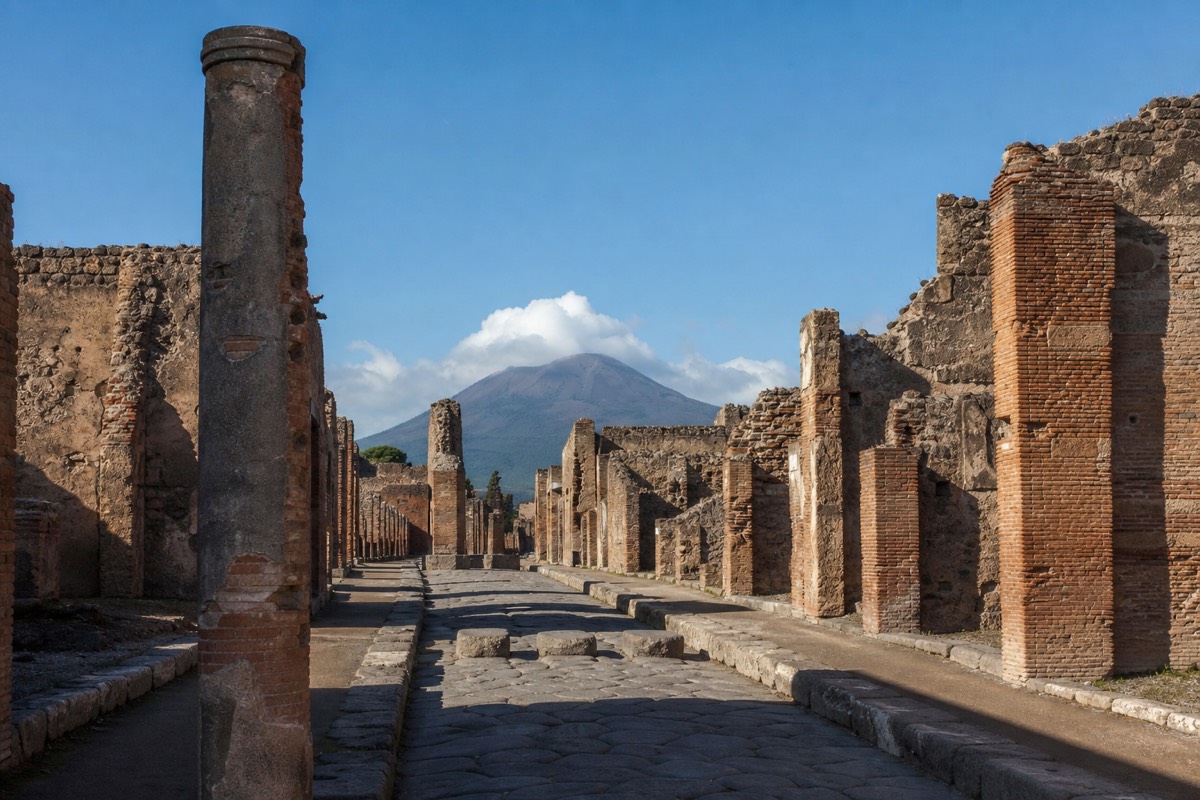
A good half-day route through Pompeii runs from the Forum with Vesuvius framed behind it, past the grand houses and the baths in the centre, out to the huge amphitheatre at the far end, then loops back by the Garden of the Fugitives. Walk it in roughly that order and you see the best of the city without doubling back across a site that takes twenty minutes to cross end to end.
Start at the Forum, the civic heart, where the columns line up under the volcano that destroyed the town. From there the Temple of Apollo and the Basilica law court sit close by. Push into the residential blocks for the House of the Faun, the grandest home in Pompeii, with the mosaics that made it famous, and the Forum Baths with their intact stucco ceilings. The Lupanar, the small brothel with its frank frescoes, and the bakeries with their grinding stones show the everyday city. Out east, the Amphitheatre is one of the oldest surviving stone arenas in the Roman world, and nearby the Garden of the Fugitives holds the plaster casts that stop every visitor in their tracks. If you have time and legs left, the Villa of the Mysteries sits just outside the walls near the far station, its wall paintings among the best preserved anywhere.
A few rooms reward the detour. The House of the Vettii, reopened in 2023 after a long restoration, shows how a wealthy freedman's home looked at its peak, with some of the brightest surviving frescoes on the site. The House of the Tragic Poet keeps its famous Cave Canem, the beware of the dog mosaic, at the threshold. And the plaster casts are the moments that stay with you: in the Garden of the Fugitives a group caught together as the ash came down, near the Forum a shelf of casts and storage jars behind glass. They are not bones but voids, the hollow shapes the bodies left in the ash, filled with plaster by the excavators, and they turn an archaeological site into something far more human.
A little route discipline pays off. Start at the Forum while it is quiet, work east through the houses and baths toward the amphitheatre, and you finish at the least crowded end of the site rather than fighting the incoming groups. There are drinking fountains dotted along the main streets, so refill as you go, and the far corners around the amphitheatre and the Garden of the Fugitives stay peaceful even when the entrance is heaving. Save the Villa of the Mysteries for last only if your legs and your train allow, since it sits back near the far gate.
| Stop | What it is | Rough time |
|---|---|---|
| Forum and Temple of Apollo | Civic square with Vesuvius behind, the oldest temple | 30-40 min |
| Basilica and Forum Baths | The law court and an intact Roman bathhouse | 20 min |
| House of the Faun | The grandest house, celebrated floor mosaics | 20 min |
| Lupanar and the bakeries | The brothel frescoes, mills and ovens of daily life | 20 min |
| Theatres and Stabian Baths | The two theatres and the town's largest baths | 25 min |
| Amphitheatre and Garden of the Fugitives | One of the oldest stone arenas, the plaster casts | 40 min |
| Villa of the Mysteries | Vivid frescoes just outside the walls (optional) | 30 min |
Pompeii Or Herculaneum: Which Ruins To Choose?
Pompeii is the bigger, more famous site with whole streets and a stadium-sized amphitheatre, while Herculaneum is smaller, far better preserved and quicker to see, so first-timers usually pick Pompeii and repeat visitors or the short-on-time often prefer Herculaneum. Both were destroyed by the same eruption, in different ways, and that difference shaped what survives today.
Pompeii was buried under ash and pumice, which crushed roofs but left a sprawling town you can walk for hours. Herculaneum was sealed by a hot mud-and-gas surge that carbonised and preserved wood, upper floors, even furniture and food, so its houses feel startlingly intact, only there are fewer of them. Herculaneum sits on the same Circumvesuviana line, at the Ercolano Scavi stop about twenty minutes from Naples, which makes swapping one for the other easy to arrange. On a single day from Rome, trying to do both is a mistake: pick one, see it well, and save the other for a return trip or a night in the south.
| Feature | Pompeii | Herculaneum |
|---|---|---|
| Size | Very large, whole streets and an amphitheatre | Compact, a few dense blocks |
| Preservation | Extensive but weathered | Exceptional, including wood and upper floors |
| Time needed | 3-4 hours minimum | 1.5-2 hours |
| Reaching it from Naples | Circumvesuviana to Pompei Scavi, ~35-40 min | Circumvesuviana to Ercolano Scavi, ~20 min |
| Best for | A first visit, the name everyone knows | Repeat visits, short on time, deep preservation |
Adding Vesuvius Or Naples To The Day
Adding Mount Vesuvius to a Pompeii day trip from Rome is too much for one day and works far better as an overnight, whereas an hour in Naples or its Archaeological Museum slots in easily on the way back. The volcano that buried Pompeii is the obvious pairing, but the timing rarely allows it once you factor in the return trains to Rome.
Vesuvius is a commitment. Reaching the crater means a bus or shuttle up to the car park at around 1,000 metres, then a walk of roughly thirty minutes up a gravel path to the rim, and the crater visit needs a timed ticket and clear weather to be worth it. The multi-day packages we list that include Vesuvius all give it its own half-day for exactly that reason, with the coach drop at the 1,000-metre mark and a hike to look into the crater. Squeezed onto a same-day return from Rome, it usually means missing most of Pompeii or missing your train.
Naples is the easier add. The Archaeological Museum holds the real treasures lifted out of Pompeii, the frescoes, mosaics and bronzes, so an hour there completes the picture the ruins only sketch. Or simply eat: Naples invented pizza, and a slice in the city on the way back is a fitting end to the day. Herculaneum, the smaller and better-preserved town near Naples, is another option, as the previous section covered, though seeing it properly means giving up most of Pompeii.
If you do make time for the museum, aim it well. The Naples National Archaeological Museum holds the Alexander Mosaic lifted from the House of the Faun, the Farnese marbles, and rooms of frescoes and everyday objects carried out of both towns for safekeeping. An hour there, ideally before or after the ruins rather than instead of them, is what joins the empty houses at Pompeii to the colour and detail that once filled them.
| Add-on | What it involves | Verdict for a Rome day trip |
|---|---|---|
| Vesuvius crater | Bus to ~1,000 m, a ~30 min walk, a timed ticket | Too much in one day, better as an overnight |
| Herculaneum | A smaller, better-preserved site near Naples | Only by skipping most of Pompeii |
| Archaeological Museum, Naples | The frescoes and mosaics taken from Pompeii | A good hour if you leave the ruins by early afternoon |
| A Naples pizza lunch | Lunch in the city that invented it | Easy, a natural stop on the way home |
Pompeii Tickets, Opening Hours And What To Bring
Choose the Pompeii ticket that covers the areas you want to visit, check the opening and last-entry times for your date, and bring water, sun cover and sturdy shoes for the uneven ancient stone. Prices and closing times change with the season, so check the official Pompeii archaeological park site for the exact date you plan to go rather than trusting an old figure.
The practical grid below covers what trips people up. Two things matter most: the lack of shade, which makes a summer midday genuinely hard, and the surface underfoot, which is original Roman paving, rutted by cart wheels and ankle-testing in the wrong shoes. Buy tickets online ahead of a peak-season visit to skip the gate queue, and carry more water than you think you need. There is a cafeteria on site, but it is busy, so many day-trippers eat near the entrance instead.
A couple of extra notes save money and hassle. Tickets are cheapest and simplest bought on the official park website, which also lists the current opening times and any closed houses, so check it the week you travel rather than trusting an old figure. The state museum system runs occasional free-entry Sundays, worth knowing but worth arriving early for, since free days draw the biggest crowds of the month. And if anyone in your group has mobility needs, Pompeii runs a marked step-free route through part of the site, detailed on the same official page.
| Item | Detail |
|---|---|
| Ticket | Check the official park site for the current ticket categories and prices |
| Opening hours | From 9:00, last entry earlier in winter than summer, confirm your date |
| Time needed | 3-4 hours for the highlights, a full day to go deep |
| Getting in | Porta Marina gate by the Pompei Scavi station, or Piazza Anfiteatro by the town |
| What to bring | Water, sun protection, sturdy closed shoes, a charged phone for maps |
| Hardest part | Almost no shade, so midday in summer is the toughest window |
When It Is Easier To Let A Tour Handle Pompeii
A do-it-yourself Pompeii day trip from Rome is very doable, but when the ruins are the whole point of your southern time, a guided package that bundles the transfers, the timed entry and often Vesuvius and Capri usually beats stitching the trains together yourself. The self-planned day works; it just asks you to hold a lot of timings in your head and hope the connections hold.
This is where a package earns its place. Pompeii can work either as a dedicated Rome-return day or as one stop during a longer stay around Naples and Sorrento. The three-day Rome, Sorrento and Capri itinerary includes Pompeii entry and a guided visit, while a guided rail day from Rome offers a same-day alternative. Compare the actual ruins time and return point before choosing. For the Rome half of the trip, our rundown of the things to do in Rome covers the city itself. If you are set on doing it independently, treat the timeline above as your plan and build in buffer at Naples.
The deciding question is a simple one: is Pompeii your whole day, or one stop on a longer trip south? As a standalone from Rome it is a rewarding but train-heavy day, best started early and planned to the minute. As part of a couple of nights based in Naples or on the coast, it stops being a race against the timetable and becomes what it should be, an unhurried walk through a Roman town that time stopped in a single afternoon.
Whichever way you go, the same short list keeps the day on track: book the fast train early, start before the heat, wear real shoes, and decide in advance whether Pompeii is your whole day or one stop on a longer trip south. If you are also weighing the coast, the Pompeii route and how to reach the Amalfi Coast share the same line south, so it is worth reading both together before you lock in dates, and thinking about how many days in Rome you want to keep for the city itself. Check the best time to visit Rome as well, since the same summer heat that bakes the city is fiercest of all on the shadeless ruins.